
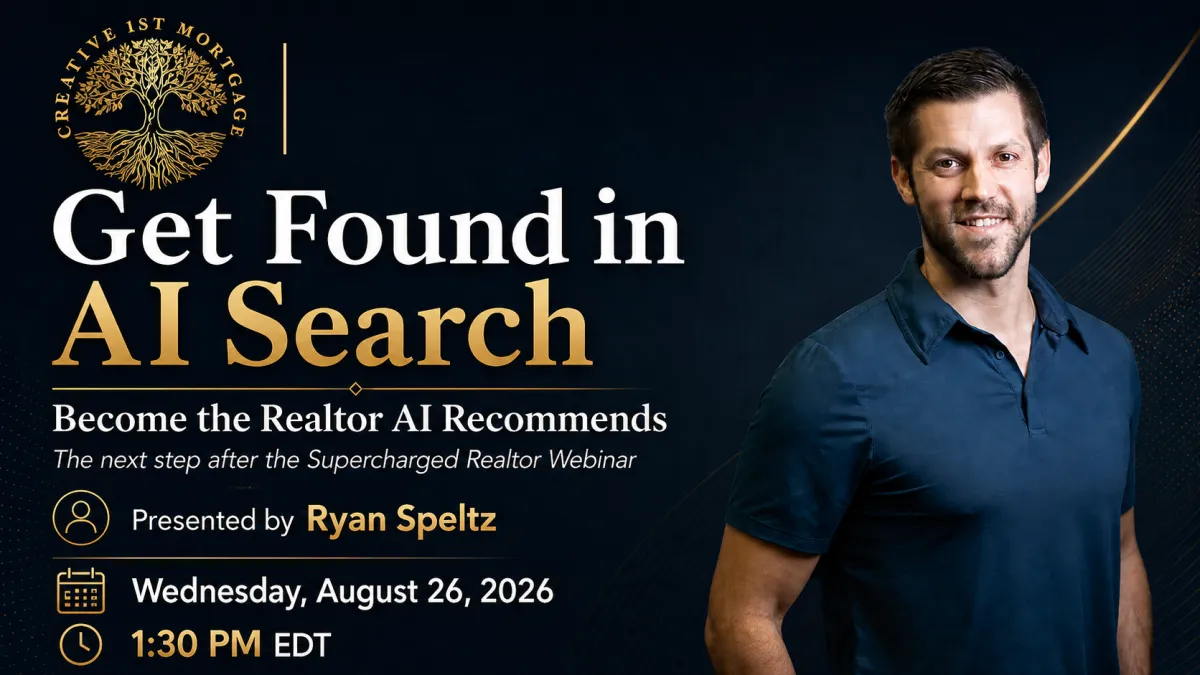
GEO for Real Estate Agents: How to Show Up in AI Search
Recorded: August 12, 2026
Written by Creative 1st Mortgage
Your next client may research you before they ever call you.
They may search your name. They may ask ChatGPT who the best real estate agent is for a certain neighborhood. They may ask Gemini what questions they should ask you. They may compare what you told them with what an AI assistant tells them five minutes after your meeting.
That does not mean AI is replacing the real estate agent.
It means the research happens sooner, faster, and in more places than it used to.
ChatGPT can search the web and return timely answers with links to web sources. Google’s AI Overviews and AI Mode also pull information from Google Search and can link people to supporting websites.
So the question I asked real estate agents in this webinar is still the right one:
Will AI recommend you?
There is no button you can push that guarantees the answer is yes. OpenAI specifically says there is no way to guarantee top placement in ChatGPT Search, and Google says meeting its requirements does not guarantee that a page will be crawled, indexed, or served.
You can still do a lot to improve the information available about you.
That is where GEO comes in.
What Is GEO for Real Estate Agents?
GEO stands for Generative Engine Optimization.
I use GEO as a practical way to think about building an online presence that AI-driven search and answer systems can understand.
I do not mean tricking ChatGPT.
I do not mean stuffing “best Realtor in Tampa” into every paragraph you publish.
I definitely do not mean creating a hundred AI-written pages that say the same thing.
The goal is simpler.
Become easy to identify, easy to understand, easy to verify, and genuinely useful around a subject people connect with your name.
There is an important factual update from how I framed this in the webinar.
I said “SEO is dead” because I wanted people to understand that the search experience is changing. Even in the webinar, I also said SEO still has a place and that GEO often looks like an extension of SEO.
Google’s current guidance makes that distinction even clearer. Google says traditional SEO practices still matter because AI Overviews and AI Mode are rooted in its existing Search ranking and quality systems. Google even says that, from its point of view, work people call AEO or GEO is still part of improving the overall search experience.
So I would not tell an agent to throw SEO away.
I would tell them the target got bigger.
You need a strong web presence for traditional search, local search, AI-assisted search, social discovery, and the person who Googles your name after somebody refers you.
This article expands the framework I taught in the Supercharged Real Estate Agent webinar, including the Plan, Vet, Verify consumer journey and the six-part G6 GEO Playbook.
Buyers Are Already Using AI to Research Real Estate
This is not a theory about something that might happen years from now.
A Realtor.com survey published in October 2025 asked 1,000 U.S. adults who were interested in buying or selling a primary residence, or had done so within the previous two years, about their information habits. Eighty-two percent reported using AI for real estate insights.
There is another part of that survey I think matters even more.
Real estate agents were still rated as the most trusted and accurate source of housing market information.
That is the opportunity.
AI can become part of how somebody gathers information without replacing the person they trust to help make a major decision.
The industry is changing on the professional side too. NAR’s 2025 Technology Survey found that 20% of respondents used AI tools daily, 22% weekly, and another 27% a few times per month. Thirty-two percent had not yet used AI in their business.
So I would not repeat the claim from the webinar that 85% of agents are regularly using AI. The broader point is still true. AI has moved into the business, but agents are at very different stages of using it.
There is time to build.
But I would not waste it.
Think About the New Consumer as Plan, Vet, Verify
One of the simplest frameworks from this webinar is Plan, Vet, Verify.
I think this is a useful way to understand what happens when a consumer has an AI assistant sitting in their pocket.
They plan
Before a buyer ever talks to you, they can ask:
What can I afford in this neighborhood?
Is now a good time to buy in St. Petersburg?
What should I expect when buying my first home?
What should a seller budget for when selling?
What questions should I ask a real estate agent?
They can walk into the first conversation with far more information than consumers used to have.
That information may be good.
Some of it may be incomplete.
Some of it may be flat-out wrong.
But they have information.
They vet
Then they hear your name.
Maybe it came from a friend. Maybe they saw a video. Maybe they met you at an open house.
Now the questions change.
Who is this agent?
What do people say about them?
Do they work with buyers like me?
Are they experienced in this neighborhood?
How does Agent A compare with Agent B?
Are there complaints about this brokerage?
Does this person actually know the subject they talk about?
That is where your digital footprint becomes part of the sales conversation whether you like it or not.
They verify
Then you finally speak with them.
You explain a contract term, market condition, property issue, negotiation decision, or next step.
There is a good chance some clients will check what you told them.
I do the same thing in my own life. When I have a problem, I usually want to search for the answer before I pick up the phone.
The professional response to that is not to be afraid of informed consumers.
Know your stuff.
Explain it clearly.
When you do not know something, say that too.
The days when a professional could say something confidently and assume nobody would check are getting harder to defend.
The G6 GEO Playbook for Real Estate Agents
During the webinar, I laid out six parts of a system I call the G6 GEO Playbook.
The six pieces are:
Consistent business information
Genuine online reviews
A clear niche
Useful community participation
A searchable YouTube presence
Long-form authority
I would make one adjustment after checking the current platform documentation.
Do not treat these as six secret AI ranking factors.
Treat them as six ways to create a stronger, clearer body of evidence about who you are, where you work, what you know, and whether people trust you.
That is a much safer way to build.
1. Clean Up Your Business Information
Start with the boring stuff.
Your name.
Your company.
Your address or service area.
Your phone number.
Your website.
Your profile information.
If one site says one thing and another says something different, clean it up.
During the webinar I talked about doing AI presence audits and finding old phone numbers, old addresses, past brokerage information, and pages people did not even know existed.
I had to do this myself.
I found older information online that did not represent where my business was anymore. That cleanup takes time, which is exactly why it should come before chasing the next marketing trick.
Google tells businesses to keep their Business Profile information complete, accurate, and current because businesses with accurate information are more likely to appear in relevant local search results.
Google also says Business Profiles can help products and services appear in both traditional Search and generative AI experiences.
That does not prove that one mismatched phone number makes ChatGPT hide you.
It does tell us that clean business information is still foundational.
Do that first.
2. Build Genuine Reviews
People trust other people.
Reviews matter because they give a future client a record of real experiences with you.
Google says local results are mainly based on relevance, distance, and prominence, and that more reviews and positive ratings can help local ranking.
So yes, ask people for reviews.
Ask consistently.
Reply to them.
Use the feedback to understand what clients actually value about working with you.
There is one part of the webinar I would change before turning it into written advice.
I talked about teaching clients to mention specific locations, buyer types, and other descriptive terms in their reviews. You need to be careful there.
A review should reflect the reviewer’s genuine experience. Google prohibits fake engagement and incentivized or biased reviews.
I would rather have a real review written in the client’s language than a perfectly keyworded review that sounds like I wrote it for them.
Ask the client what stood out.
Then let them tell the truth.
That is better marketing anyway.
3. Own a Clear Niche
This is the place where a lot of real estate professionals fight me.
“I do everything.”
I get it.
Deals are deals.
You do not want your marketing to make somebody think you cannot help them.
Picking a subject to be known for does not mean refusing every other client.
It means giving people something clear to remember.
Maybe you are the person who understands first-time buyers.
Maybe you know downtown St. Petersburg condos.
Maybe you know relocation.
Maybe you understand waterfront property.
Maybe you work deeply with self-employed professionals.
Maybe your world is investment property.
The specific answer matters less than the decision to stop marketing yourself as somebody who does everything for everybody.
Google’s current AI search guidance tells publishers to create useful content with a unique point of view and real first-hand experience rather than recycling generic information that anybody could produce.
That fits the niche idea perfectly.
Do not publish another generic article called “7 Tips for Buying a Home.”
Tell me what you have actually learned helping a certain kind of person solve a certain kind of problem.
That is something worth finding.
4. Answer Real Questions Where People Ask Them
In the webinar I pointed toward Reddit and Quora.
The point was never “go spam Reddit so ChatGPT mentions you.”
That would be terrible advice.
The point is to show up where people are asking hard questions and help without trying to turn every answer into a sales pitch.
Google specifically says its generative AI search features may surface information from blogs, videos, and forum discussions. It also warns that trying to manufacture fake mentions across the web is not a useful strategy.
That gives us a pretty clear line.
Participate because you can help.
Answer the question fully.
Do not lead with “I’m an agent, call me.”
Do not create fake accounts to praise yourself.
Do not drop links where they add no value.
If somebody is asking a first-time buyer question and you know the answer, answer it.
That useful footprint can create visibility.
It can also create something even more valuable.
Trust.
5. Build a YouTube Library Around Real Questions
I have created a lot of video.
One thing I know from experience is that long-form content gives you somewhere to actually explain what you know.
A 15-second video can get attention.
A real explanation can build confidence.
Your YouTube channel does not need to become a television studio.
Start with the questions your clients already ask you.
What does a buyer consultation actually cover?
How do condo inspections work in Florida?
What should a first-time buyer understand before touring homes?
How do you evaluate a neighborhood?
How do multiple offers work?
What mistakes do sellers make before listing?
What questions should you ask before choosing an agent?
Google confirms that relevant images and video can appear in generative AI search experiences, creating more ways for sites and creators to surface beyond a standard blue link.
What I would not say is that having a YouTube channel is automatically a direct Gemini ranking factor.
Google does not document that.
Build the videos because they prove your thinking, help humans, create searchable material, and give you a library of original experience to reuse elsewhere.
That is enough reason.
Check out Ryan's Personal Youtube Channel Here.
Check out the Creative 1st Mortgage Youtube channel Here.
6. Create Long-Form Authority
In 2019, before I was talking about GEO, I wrote a short A-to-Z homebuying book.
I sat in a coffee shop, built the table of contents, and wrote short chapters around each part.
The book did not need to be 400 pages.
The value was that I had taken what I knew and organized it.
I still like this idea.
Just do not confuse “published author” with an automatic AI authority badge.
No major AI search platform says that writing a book makes somebody an expert by default.
The real opportunity is that long-form work forces you to define what you know.
A book can become:
Articles
Videos
FAQs
Client education
Podcast topics
Social clips
Email material
Presentation material
The same thing can happen with a strong long-form guide on your website.
Google’s own AI search guidance favors original, expert-led content that contributes something beyond common knowledge.
So write something worth reading.
The authority comes from the work, not the label.
One Technical GEO Step Most Agents Will Miss
Most of this playbook is about content, reputation, and clarity.
There is also a technical piece.
Your content has to be accessible.
For Google’s generative AI search experiences, a page needs to be indexed and eligible to appear in Search. Google recommends maintaining a crawlable site with a clear technical structure.
OpenAI says any public website can potentially appear in ChatGPT Search. It recommends allowing its OAI-SearchBot crawler if you want site content to be discoverable, surfaced, cited, and linked in ChatGPT search results.
So somebody on your team should check:
Can Google crawl the website?
Is the site indexed?
Is important content hidden behind scripts or logins?
Is OAI-SearchBot blocked in robots.txt?
Are your business details clear on the site?
Is there one strong page for each subject you truly know?
Are old or duplicate pages creating confusion?
Do not spend six months on technical tweaks before creating anything useful.
Just make sure the doors are unlocked.
What GEO Will Not Do
There is a lot of nonsense starting to show up around AI search.
You do not need another shiny object.
Google now directly warns site owners against several supposed GEO shortcuts. It says there is no need for special AI text files such as llms.txt for Google Search, no special requirement to break every article into tiny chunks, and no reason to rewrite everything solely for AI systems. It also warns against manufactured mentions and mass-producing content simply to manipulate rankings.
OpenAI also makes no promise that allowing its crawler means you will rank first or even be surfaced for a particular query.
So stop looking for the button.
There isn't one.
The better question is whether your online presence gives a search system enough reliable information to understand what you actually do.
AI Can Help Somebody Find You. It Cannot Finish the Relationship.
This was the second half of the webinar, and I think it is the part people are going to forget while everybody chases AI.
You can become great at marketing and still lose the client.
You can rank.
You can get cited.
You can have 500 reviews.
You can build a beautiful YouTube channel.
Then you get on the phone and sound desperate, distracted, pushy, or uninterested.
Game over.
My new ABCs of sales are:
Always be contacting
Always be connecting
Always be curious
Always be closing
Always be cool
Closing is one part of selling.
Selling is the whole relationship.
Curiosity means actually listening.
Connecting means understanding the person instead of waiting for your turn to talk.
Being cool means not dragging your anxiety about needing a commission check into somebody else's decision.
That is the piece AI does not solve for you.
One of my core points from the webinar was that the skill you cannot afford to lose is the ability to make another human trust you.
The research around AI and real estate actually supports that direction. Realtor.com’s survey found heavy use of AI for housing information while still finding that real estate agents were viewed as the most trusted and accurate source. NAR’s 2025 technology survey made a similar point, saying technology use was growing while the trusted agent-client relationship remained central.
That is where the real opportunity sits.
Use the technology.
Build the presence.
Then be a professional worth trusting.
A Practical 30-Day GEO Starting Plan
If I were starting this from zero, I would do the work in this order.
Week 1: Clean Up
Search your name and business.
Check your website, Google Business Profile, brokerage pages, Realtor.com, Zillow, social profiles, directory listings, old bios, and anything else that comes up.
Fix inaccurate information.
Week 2: Define What You Want to Be Known For
Pick one primary audience, place, property type, or problem.
Write down 20 questions that person regularly asks.
Those questions become your content plan.
Week 3: Build Proof
Create a consistent system to ask real clients for honest reviews.
Reply to existing reviews.
Publish useful answers to several of your 20 questions.
Answer relevant community questions where you can genuinely contribute.
Week 4: Go Deeper
Record several videos.
Turn your strongest topic into a detailed guide.
Make sure that guide lives somewhere on your own website where search systems can crawl it.
Then keep going.
You are not trying to “finish GEO” in 30 days.
You are building a body of work.
That compounds.
Frequently Asked Questions
What does GEO mean in real estate marketing?
GEO stands for Generative Engine Optimization. For a real estate professional, it means making your online presence clear, credible, useful, and accessible enough to have a chance of appearing when AI-driven search systems answer real estate questions.
Is GEO replacing SEO?
No. Google says its generative AI search features still rely on core Google Search ranking and quality systems. GEO is better treated as an extension of strong search, content, reputation, and entity-building practices rather than a complete replacement for SEO.
Can I guarantee that ChatGPT will recommend me?
No. OpenAI says ChatGPT Search rankings use multiple factors intended to surface reliable and relevant information, and there is no way to guarantee top placement.
Do Google reviews matter?
Yes, especially for local search and consumer trust. Google says more reviews and positive ratings can help local ranking. Reviews should represent genuine customer experiences and should not be manipulated or incentivized.
Does YouTube help real estate agents with AI search?
Video can create another searchable source of useful information about your expertise. Google says videos can appear in generative AI search experiences. That does not mean having a YouTube channel guarantees an AI recommendation.
Should real estate agents use Reddit or Quora for GEO?
Use them when you have something useful to contribute. Forum discussions can surface in search and generative AI experiences, but manufactured mentions, spam, and self-promotion are not a sound long-term strategy.
Do I need to become an author to build authority?
No. Writing a book or detailed guide can help you organize and demonstrate real experience, but publishing something does not automatically make an AI system treat you as an expert. The work has to be useful.
What is the most important part of the G6 playbook?
Start with clarity. Make sure the internet can accurately identify who you are, where you work, and what you actually know. Then build useful proof around that identity through reviews, content, community participation, video, and deeper expertise.
The Point
AI is changing how people find answers.
That part is real.
What I do not want real estate professionals doing is panicking and chasing every new shortcut somebody sells as the secret to ChatGPT.
Clean up your presence.
Know what you want to be known for.
Answer real questions.
Create useful work.
Build genuine reputation.
Give search systems good information to work with.
Then remember that getting discovered is only the first half.
The person still has to trust you.
And you still have to earn that.
Ryan Speltz | NMLS# 1277170 | Creative 1st Mortgage | NMLS# 2614631 | Licensed in FL, MN, TX, AL, KY & TN. This is not a commitment to lend. All loans subject to credit approval, income verification, and property eligibility. Program terms and availability subject to change without notice. FHA loans require mortgage insurance. Down payment assistance is provided as a second mortgage lien. Restrictions may apply.