
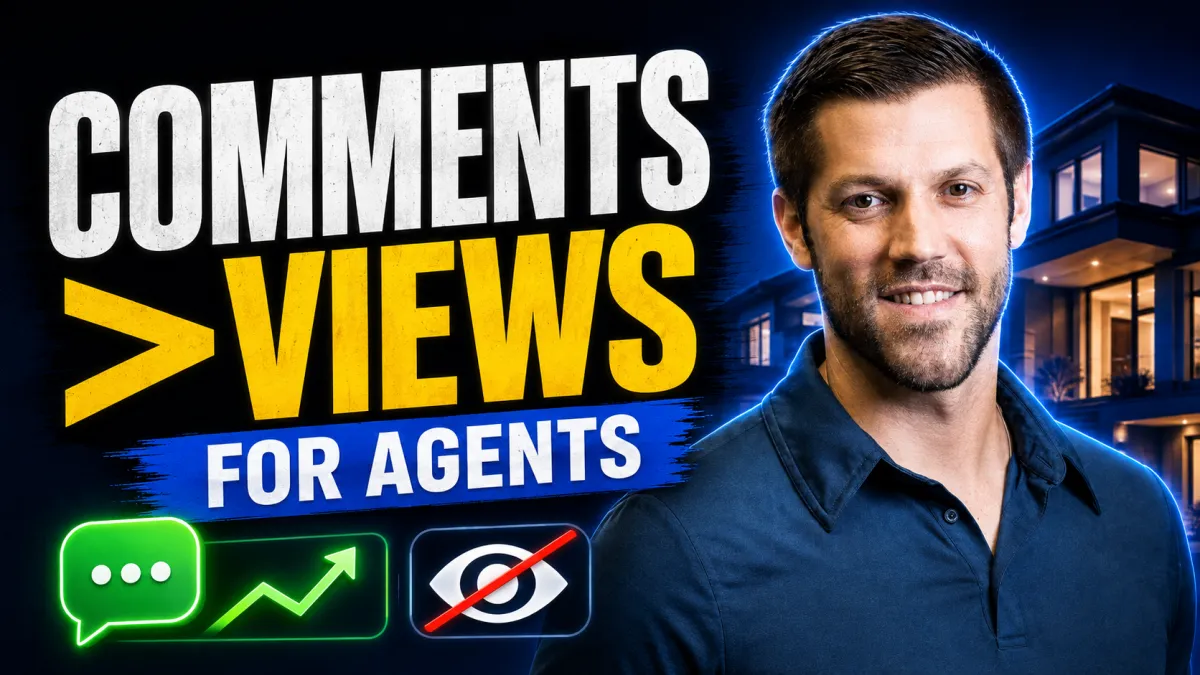
Social Media Strategy for Real Estate Agents: Turn Comments Into Conversations
Stop Chasing Views: How Real Estate Agents Turn Social Media Comments Into Conversations
Most real estate agents do not have a posting problem.
They are posting. They are making videos. They are sharing listings, market updates, open houses, closings, and whatever else they have been told they need to put on social media.
The problem is what happens after they hit publish.
A post gets 1,500 views. Maybe 5,000. Maybe 50,000.
Cool.
Did anybody actually talk to you?
That is the question I think we need to ask more often.
For real estate agents, social media can absolutely produce business. The National Association of REALTORS® reported in its 2025 Technology Survey that 75% of REALTORS® use social media and 39% said social media produced the highest number of quality leads among the technologies surveyed.
So the issue is not whether real estate agents should be on social media.
The better question is what you are trying to get people to do once they see you.
My answer is simple.
Start a conversation.
That is what I mean by a comment-first content strategy.
What is a comment-first social media strategy?
A comment-first strategy is content designed to make a real response easy.
Instead of starting with:
“What should I post today?”
Start with:
“What could I post that somebody would actually want to respond to?”
That change sounds small. It changes the whole job.
You stop treating the post like a finished product. The post becomes an invitation into a conversation.
That means I am not talking about begging people to type a word in the comments just so you can juice your numbers. Facebook has specifically pushed back against spammy engagement tactics, and Meta said again in 2025 that accounts trying to game distribution or manufacture engagement can see less reach.
Real conversation is different.
You ask something your audience actually has an opinion about. They answer. You respond. You ask another question. Now two people are talking.
That is useful whether the platform gives you another 100 views or another 10,000.
If you want to see the full framework, examples, and weekly posting plan, this webinar walks through the entire comment-first strategy for real estate agents.
Why views can become a bad social media scorecard
Views are easy to measure, which is probably why we become obsessed with them.
They are sitting right there underneath the post.
The danger is starting to believe a big number automatically means the content moved your business forward.
I learned that one the fun way.
I had a TikTok post go viral. It was basically a stupid video that happened to include my feet and somehow the internet grabbed onto it.
The post got a pile of views.
It produced zero business for me.
That changed how I looked at the scoreboard.
There is nothing wrong with reach. You need people to see your content. The problem comes when reach becomes the finish line.
If 20,000 people watch something and nobody remembers who you are, talks to you, or moves any closer to trusting you, what did the number really accomplish?
For somebody building a relationship-based business, I would rather understand the conversation created by the post.
Did someone ask a real question?
Did a homeowner tell you why they are afraid to sell?
Did a buyer explain what is confusing them?
Did another agent share what is working at their open houses?
Did somebody come back and respond again?
Those are signals you can actually do something with.
Do comments really help Facebook reach?
They can, but I would not build this strategy around a promise that every comment automatically creates more reach.
Meta has publicly explained that Facebook Feed ranking uses many signals and predictions. Those signals can include whether someone is likely to comment, react, share, or otherwise engage with a post. Meta has also said interactions with comments and replies can affect how public comments are ranked.
That is different from saying, “Comments control the algorithm.”
They do not.
There are a lot of factors involved, and those systems change.
So I would not spend my day trying to hack Facebook.
Make something relevant. Give somebody a reason to answer. Respond like a human being.
That strategy survives an algorithm change because the relationship is the part you actually own.
What does comment-first content look like?
The best comment-first posts usually have one thing in common.
They are easy to answer.
You are not asking someone to stop what they are doing and write a five-paragraph essay about the housing market.
You are lowering the friction enough that somebody can participate.
Here are four formats I use.
1. Binary-choice posts
Give people two choices.
That is it.
For example:
Would you buy now or wait?
Open houses: worth the time or skip them?
Would you rather have a lower rate or reduce your cash needed at closing?
The mortgage example needs to stay educational because actual loan choices depend on the borrower, loan program, property, qualifications, and current terms. The value of the post format is the simplicity of the question.
People do not have to invent an answer. They choose a side and tell you why.
The “why” is where the good conversation normally starts.
2. Finish-the-sentence posts
Give people the beginning and let them finish it.
For example:
The biggest mistake buyers make is ______.
Buyers are most confused about ______.
The question I get asked most is ______.
The thing I wish every seller understood is ______.
These work because every person can bring their own experience into the post.
You also get something else from these responses: market research.
If eight people tell you they are confused about the same thing, you probably just found your next piece of content.
You did not have to sit at your desk trying to dream up an idea.
Your audience told you what they need.
3. Opinion-permission posts
This is where you are willing to have a point of view.
You might start with:
“I could be wrong, but…”
Or:
“Unpopular opinion…”
Or simply state something you believe and give people room to disagree.
This part matters.
You do not need to turn yourself into some fake internet character who argues with everybody.
I make posts my own team tells me they would never make. That is fine. I am me and they are them.
The goal is not to borrow somebody else’s personality.
Stay inside your character. Say what you actually believe. Then let somebody disagree without treating disagreement like an attack.
A person can disagree with your opinion and still respect how you handled the conversation.
That tells them a lot about what working with you might feel like.
4. Local call-out posts
Real estate is local, so give local people a reason to identify themselves.
Examples could be:
Buyers in St. Petersburg, what is confusing you most about the market right now?
First-time buyers in Tampa Bay, what is the biggest thing making you hesitate?
Sellers in your neighborhood, what would have to happen before you would consider moving?
Agents in your area, are open houses still worth your time?
I like these because they are not pretending you serve everybody everywhere.
You are talking to a real community.
That creates useful content even if nothing magical happens with the platform.
You start learning what the people in your actual market are thinking.
Posting is only half the job
This may be the biggest mistake I see.
You put all this pressure on yourself to create the perfect piece of content.
Then somebody finally comments.
And you do nothing.
The person did exactly what you wanted them to do.
They raised their hand.
Respond.
If they answer you again, respond again.
Ask a follow-up question when it makes sense.
The content got them into the room. Now you have to have the conversation.
My basic flow looks like this:
Post → Comment → Reply → Follow-up Question → Private Conversation → Appointment when appropriate
Notice what is missing.
The pitch.
You do not need to jump on the first comment and say, “Looks like you need a Realtor. Here is my Calendly.”
Nobody likes that.
Have the conversation first.
How should a real estate agent respond to comments?
Treat the person like they are standing in front of you.
If they give you an opinion, do not just reply:
“Great point!”
Give them something to respond to.
If somebody says they would wait to buy, you could ask what would need to change before they felt comfortable moving.
If somebody says open houses are a waste of time, ask what has worked better for them.
If somebody says their biggest fear is the monthly payment, you now know what the real concern is.
Your job is to understand before you decide whether there is any business conversation there.
Sometimes there will be.
Sometimes there will not.
Both are okay.
Not every person who talks to you needs to become a lead.
That is part of why the conversation feels different.
When should you move a social media conversation into a DM?
Move it when there is a natural reason to continue privately.
In the webinar, I talked about sometimes waiting until the following week and sending a simple message thanking the person for interacting with the post and mentioning the opinion they shared.
That is a much warmer starting point than messaging a stranger:
“Hey, are you looking to buy or sell?”
They already know why you are talking to them.
You already know something about how they think.
If the conversation shows that they are actually considering buying or selling, you can ask whether they want to have a real conversation about what that looks like.
That is the difference between cold outreach and warmed-up outreach.
Do not manufacture the opportunity.
Pay attention when the opportunity is already there.
Open houses are content gold mines
Agents tell me all the time they do not know what to post.
Go work an open house.
Listen.
Every real question somebody asks you can become future content.
You could post:
“Here is a question a buyer asked me at today’s open house that surprised me…”
Or:
“Guess how many groups came through today’s open house.”
Or:
“Almost every buyer who came through today asked about the same thing.”
Or take a common reaction to the house and turn it into a discussion:
“People thought this home was overpriced until they saw the kitchen. What feature changes your opinion of a home the fastest?”
Now your content is coming from real life.
That is a lot easier than opening a blank screen every morning and trying to become a content genius before your first cup of coffee.
More important, these are questions and conversations that real buyers and sellers are already having.
A simple weekly social media plan for real estate agents
You do not need 47 different content buckets.
Take the formats above and build a week around them.
DayPost TypeMain JobMondayBinary choiceMake responding easyTuesdayFinish the sentenceLearn what people thinkWednesdayLocal call-outCreate local conversationThursdayOpinion-permissionShow people how you thinkFridayOpen house or real-world recapTurn your work into content
There is another step on every single day:
Reply to the people who respond.
If your entire strategy is posting five times and disappearing, you missed the useful part.
What should real estate agents measure on social media?
Views still have a place. I just would not let them run the meeting.
I would pay attention to:
Real comments
Unique people commenting
Repeat commenters
Follow-up conversations
Relevant DMs
People who come back to another post
Appointments that started from social interaction
Client and referral conversations influenced by your content
You may only get five useful comments on a post.
That can be a good post.
One of those five people could become somebody you know for the next ten years.
Do not let a vanity number make you overlook an actual relationship.
Can social media content help you appear in AI search?
Potentially, but I would be careful with this claim.
ChatGPT Search can search the public web and provide links to web sources. Other AI products have their own retrieval systems, partnerships, indexes, and rules.
That does not mean every Facebook post, Instagram comment, or social thread will be found, indexed, or cited by ChatGPT, Claude, Gemini, Grok, or another AI product.
Nobody should promise you that.
What you can control is creating a clear online footprint around who you are, what market you serve, what you know, and how you help people.
Your website, useful articles, YouTube content, business profiles, interviews, citations around the web, and public social presence can all be parts of that footprint.
The point of comment-first content is still the same even if an AI tool never sees the post.
A real human did.
You got the chance to talk to them.
The real goal is familiarity
Real estate is a relationship business.
People need enough familiarity to feel comfortable trusting you with a big decision.
Social media gives you a way to build some of that familiarity before the first appointment ever happens.
People can watch how you answer questions.
They can see whether you actually respond.
They can see how you handle someone who disagrees with you.
They can see whether you understand your local market.
By the time somebody finally needs an agent, you do not want to feel like a complete stranger.
That is where I think social media becomes useful.
You are not trying to become famous.
You are giving the right people enough opportunities to know you before they need you.
So stop putting all the pressure on the post.
Create something somebody can answer.
Then answer them back.
Posting is only half the job.
The conversation is where the work starts.
Ryan Speltz | NMLS# 1277170 | Creative 1st Mortgage | NMLS# 2614631 | Licensed in FL, MN, TX, AL, KY & TN. This is not a commitment to lend. All loans subject to credit approval, income verification, and property eligibility. Program terms and availability subject to change without notice. FHA loans require mortgage insurance. Down payment assistance is provided as a second mortgage lien. Restrictions may apply.
FAQ
What is a comment-first content strategy for real estate agents?
A comment-first strategy creates social posts that make it easy for people to give an opinion, answer a question, or share an experience. The agent then responds and develops useful conversations instead of treating the original post as the end of the process.
Are views useless for real estate agents?
No. Reach helps people discover you. The problem is treating views as proof that a post created business value. Track conversations, repeat interactions, DMs, appointments, and relationships alongside reach.
Should real estate agents reply to every social media comment?
Reply to genuine comments whenever practical. The response should add something to the conversation instead of being a generic acknowledgment. Spam, abuse, fake engagement, and comments that do not deserve a response can be handled differently.
What kinds of social media posts get people talking?
Low-friction questions work well. Examples include binary choices, finish-the-sentence prompts, thoughtful opinion posts, local questions, and posts based on conversations that happened during normal real estate work.
How do I turn a social media comment into a real estate lead?
Do not immediately treat the person like a lead. Respond publicly, understand what they are saying, ask a relevant follow-up question, and move into a private conversation only when there is a natural reason. If they have a real estate need and want help, that conversation may lead to an appointment.
Is asking people to comment considered engagement bait?
It can be if the post exists mainly to manipulate engagement. Meta has specifically said it reduces spammy tactics intended to game distribution. Asking a genuine question that is relevant to your audience is different from manufacturing meaningless interactions.
Will more comments automatically increase Facebook reach?
No. Facebook uses many signals to decide what people see. Comments and replies can be part of those signals, but there is no reliable formula where a certain number of comments guarantees additional distribution.