
Video Content Strategy for Realtors and Loan Officers
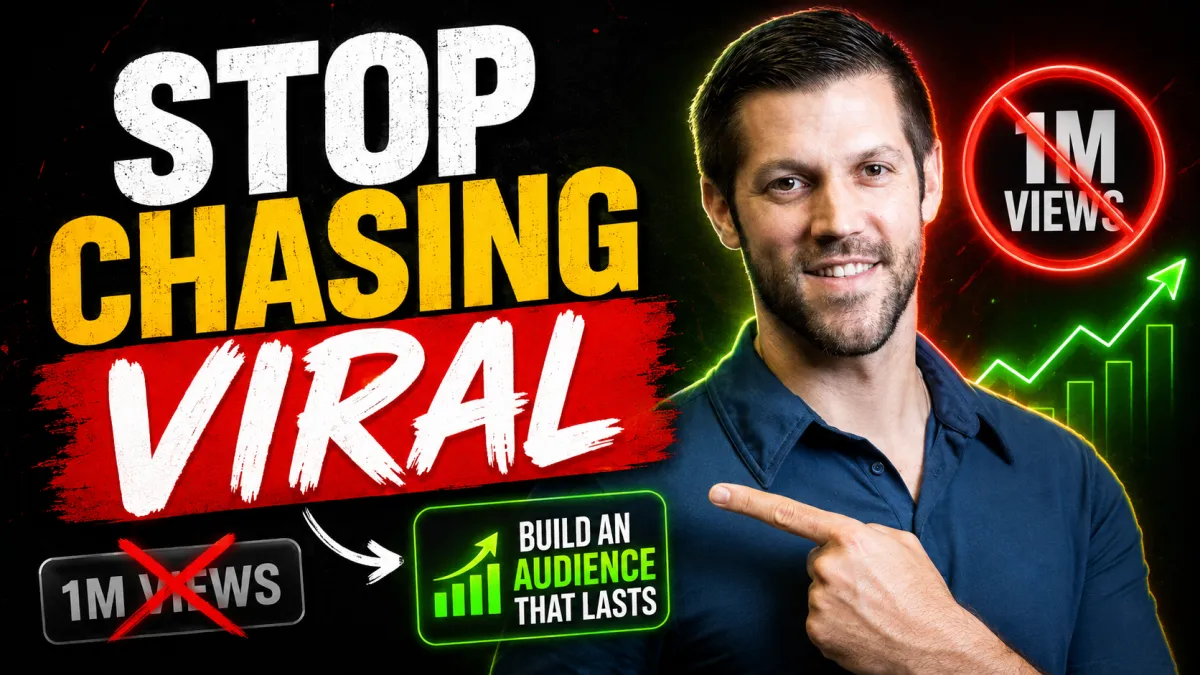
Stop Chasing Viral Videos. Build a Content Bank That Actually Helps Your Business.
If you are a Realtor, loan officer, or anyone else whose business depends on relationships, your first goal with video should not be going viral.
Build something useful.
Build a library of videos that answer the questions people already ask you. Explain the things you find yourself explaining every week. Let people see how you think and what it feels like to work with you.
That is the content that can keep working even when the view count is nothing impressive.
I learned that by doing it the long way.
This idea came out of a longer conversation about fear, consistency, viral content, and what video can actually do inside a relationship-based business.
I Did Not Start as a “Content Creator”
I started taking video seriously around 2017 after attending a mortgage coaching event where video kept coming up over and over again.
So I went home, bought a ring light and a little microphone for my phone, and started recording.
I was not consistent.
I did a few videos here. A few there. Like most people starting out, the first problem in my head was simple:
What am I supposed to say?
That question feels legitimate when you are staring at the camera.
Most of the time, it is just an excuse wearing better clothes.
Once I started making videos, I realized there was no shortage of things to talk about. My clients already gave me the topics. My business gave me the topics. The questions I answered over and over again gave me the topics.
The bigger hurdle was getting comfortable enough to say them on camera.
Start With Video Inside Your Actual Business
One of the smartest things I did early had very little to do with social media.
I started putting video into my normal client communication.
Instead of thinking, “I need to post something for thousands of strangers,” I could record something meant to help one person.
That changed the feeling completely.
There was less pressure because I knew who I was talking to. I knew the problem. I knew what they needed from me.
Then I could take that same skill into public content later.
If public video feels like too big of a jump right now, start smaller.
Record a quick video for a client.
Send somebody a video update instead of typing another long message.
Answer a question with your face and your voice instead of sending another paragraph.
You are still practicing the same skill.
You are learning how to explain something clearly, look at the camera, hear your own voice, stop worrying about whether your face looks weird, and get comfortable being seen.
That is progress.
Your First Videos Do Not Need to Be Brilliant
If I were sitting next to a brand-new Realtor or loan officer who had never posted a video, I would not start by building some huge content calendar.
I would make them record an introduction.
Who are you?
What do you do?
Who do you help?
What do you actually care about?
Done.
You have made a video.
Now answer another question:
What is one thing your clients need to understand about the process you help them through?
Record that.
You now have two pieces of content.
The point is to remove the drama around creating.
You do not need 47 hooks, a studio, five cameras, a perfect content calendar, or some complicated system before you are allowed to start.
You need something worth saying and the willingness to press record.
Stop Treating Virality Like the Goal
One of the strangest moments in my own social media experience came from a random TikTok I recorded at Home Depot.
I thought I had made some funny, relatable husband content.
The video started taking off.
Then I figured out why.
My sandals and feet were in the video, and apparently a completely different corner of TikTok had found me.
That was a pretty good lesson.
A lot of views do not automatically mean you reached the right people.
A video can travel a long way and still have very little to do with the business you are trying to build.
That changed the way I looked at social media.
I stopped needing the viral hit.
Instead, I started thinking about building a content bank.
What Is a Video Content Bank?
A video content bank is a collection of useful videos you can keep coming back to.
It should answer common questions, explain your process, address concerns, show how you think, and help somebody understand whether you are the kind of person they want to work with.
The real value shows up when somebody asks you a question and you can say:
“I actually made a quick video explaining that. Here it is.”
You just helped them without turning every question into another ten-minute phone conversation.
That does not mean you stop having real conversations with people. Relationships still matter.
It means you stop rebuilding the same answer from scratch every single time.
Your knowledge becomes reusable.
And because the answer exists publicly, other people with the same question can find it too.
A Small Audience Can Still Be the Right Audience
This is where people get sideways with social media.
You post something and it gets 200 views.
Then you see somebody else getting 200,000.
Now your content feels like a failure.
But what if three of those 200 people are exactly the people you wanted to reach?
What if a client finds the answer they needed?
What if a referral partner sends your video to somebody because you explained the subject better than they could?
What if somebody watches ten of your videos over six months before they ever contact you?
Those numbers do not look sexy on a screenshot.
They can still matter to your business.
Views are information.
They are not your identity.
Your Best Content Ideas Are Probably Already Happening Around You
People ask me where content ideas come from.
For me, there has never been one perfect system.
Sometimes an idea hits while I am working out or listening to an audiobook. I write it down.
Sometimes I have saved ideas sitting there for a day when nothing is coming to me.
At the time of the podcast interview, I had a running list with dozens of video ideas so I always had something to fall back on.
But I would start somewhere even simpler.
Pay attention to your business for one week.
Every time somebody asks you a question, write it down.
Every time you explain the same concept twice, write it down.
Every time you hear bad advice and think, “That is not how this works,” write it down.
Every time something happens and you wish your clients understood the reason behind it, write it down.
There is your content list.
Your job is not to invent a personality for social media.
Your job is to pay attention.
Record the Idea While You Still Care About It
Something else I learned about myself is that I make better videos when the idea is alive.
If something happens and I immediately think, “I have something to say about that,” I would rather record it then than schedule it for three weeks from now.
There is emotion behind it.
I actually care.
That comes through on camera.
You can feel the difference between somebody explaining something they believe and somebody reading something they thought they were supposed to post.
A content list is helpful.
Do not let the content list turn you into a robot.
Fear Is Usually the Real Problem
When somebody tells me they do not know what to post, the issue often goes deeper.
They are scared.
What are people going to think?
What if nobody watches?
What if somebody makes fun of me?
What if I say something stupid?
What if people from high school see it?
There are a hundred versions of the same fear.
One thing we talked about during the podcast was asking yourself one question:
Why?
Why am I afraid to post this?
Then question the answer.
Why does that bother me?
Keep going.
You may need to ask it four or five times before you get to the thing you are actually afraid of.
Once you know what that thing is, at least you are dealing with the real problem instead of pretending you need another content calendar.
Being Yourself on Camera Takes Practice
My early videos looked different from the way I eventually showed up.
I was a mortgage professional, so I thought I had to look and sound like what I believed a mortgage professional was supposed to look and sound like.
Over time, video helped strip some of that away.
I got more comfortable.
I started sounding more like myself.
That mattered beyond social media.
During the podcast conversation, I talked about how that period of creating video overlapped with a much bigger season in my own life, including my sobriety and figuring out more clearly who I was.
Video became part of that process.
That is why I do not think personal branding should mean manufacturing a character.
If people are eventually going to meet you, talk to you, sit across from you, or trust you with something important, give them a chance to see the real person.
Professional does not have to mean fake.
Build Around Questions, Not Algorithms
Algorithms change.
Platforms change.
Features change.
The questions people ask you are much more stable.
That is another reason I like the idea of building a content bank.
You can distribute the same useful idea in different ways.
One answer might become:
A short vertical video
A longer educational video
A blog article
A client follow-up
A social post
A section of a webinar
A resource you send to a referral partner
You do the hard thinking once, then let the idea keep working.
And the platforms themselves increasingly give creators ways to connect short and long content. As of July 2026, YouTube's official creator guidance describes its Related Video feature as a way to connect a Short directly to longer videos or other content on the same channel.
That makes a connected library more useful than a pile of unrelated posts.
A Simple Starting Plan for Realtors and Loan Officers
If you have been putting video off, I would keep the first month simple.
1. Record an introduction
Tell people who you are, what you do, and what matters to you.
Do not worry about making this the final version of your life story. You can record another introduction later.
2. Answer your five most common questions
You already know these.
Do not write an essay.
Answer each one the same way you would answer a real person sitting across from you.
3. Record one question every time it comes up
Your clients are now building your content calendar for you.
4. Keep a running idea list
Use whatever tool you will actually open.
The specific app matters less than having one place where ideas go before you forget them.
5. Start one-to-one if public posting still feels too big
Send videos directly to people.
Get used to the camera.
Then widen the audience when you are ready.
6. Pay attention to usefulness before vanity metrics
Look at what questions people respond to.
Notice what gets shared.
Notice what starts conversations.
Do not let one low-view video convince you the whole strategy is broken.
7. Keep building the bank
After six months, the goal is not to tell people you posted 100 times.
The goal is to have 100 useful things you can point people toward.
That is a much better asset.
The Point of Video Is to Help People Know You Before They Need You
There is nothing wrong with wanting more reach.
Reach can help.
But reach without relevance does not solve much.
For a relationship business, video gives people a chance to hear your thinking before they ever call you. They can understand how you explain things. They can see your personality. They can decide whether they trust the way you approach the work.
And when they finally have a question, there is a good chance you already answered it.
That is what I want the library to become.
Not proof that I can get views.
Proof that I have something useful to say.
FAQ
What should a Realtor or loan officer talk about on video?
Start with questions you already answer in your business. Explain common parts of your process, mistakes people make, questions clients ask repeatedly, things people misunderstand, and lessons from real situations you encounter.
You do not need to invent topics when your business is already producing them.
What should my first social media video be?
A simple introduction is enough.
Explain who you are, what you do, who you help, and a little about what matters to you. The real win is getting the first recording finished so the next one feels easier.
What if I am afraid to post videos?
Start by recording one-to-one videos for people you already know. It gives you practice explaining things on camera without feeling like you are performing for the entire internet.
If the fear keeps stopping you, ask yourself why you are afraid and keep questioning the answer until you reach the real reason.
Do business videos need to go viral to work?
No.
A business video can be useful with a small audience if it reaches the right people, answers a real question, helps a client, or becomes something you can send again later.
The content bank matters more than a single spike in views.
How do I create enough ideas to post consistently?
Keep a running list based on real questions and conversations.
When somebody asks something worth answering, save it.
When you explain the same issue repeatedly, save it.
When you hear advice you disagree with and can explain why, save it.
You will probably find that your problem was never a lack of topics.
Should I reuse old video topics?
Yes.
Your audience does not see every post you make, and useful questions come up repeatedly. The goal is to explain the subject clearly, not prove that you can invent a brand-new idea every day.
You can also connect short-form and long-form content instead of treating each post as an isolated piece. YouTube currently lets creators attach a related video from their own channel to a Short.