
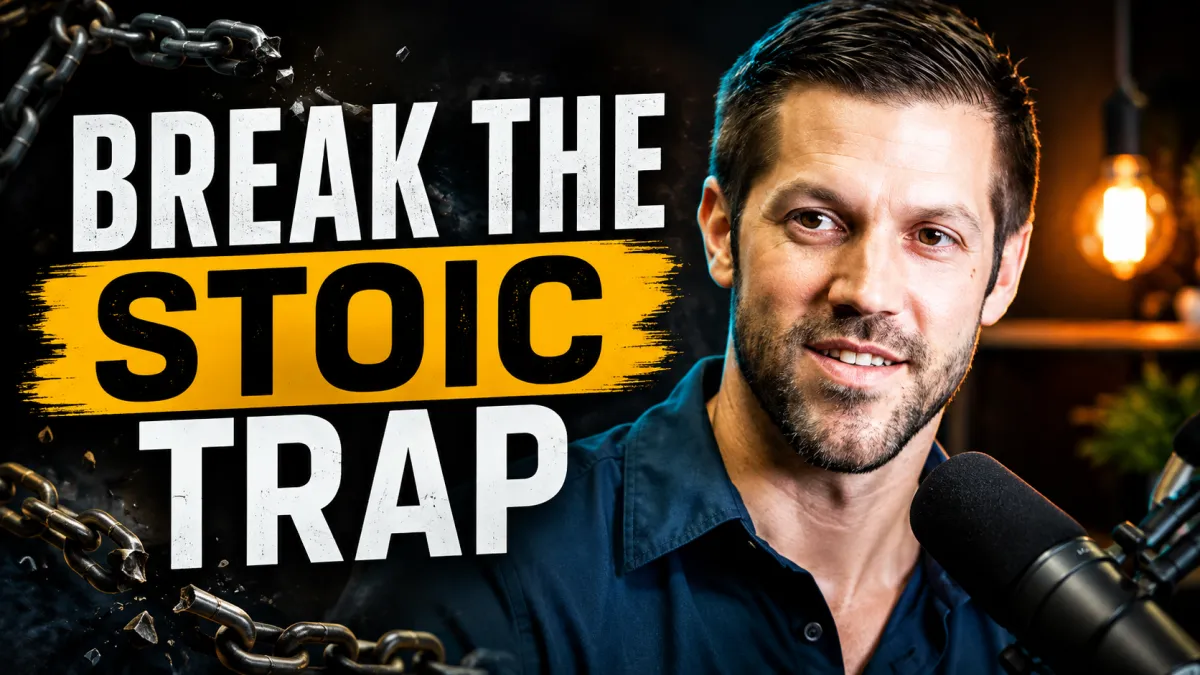
Why Vulnerability Makes Men Stronger Without Oversharing
Why Vulnerability Makes Men Stronger: Building Real Connection Without Oversharing
A lot of men have been taught some version of the same lesson.
Handle it yourself. Be the rock. Keep moving. Do not let people see the cracks.
I grew up in small-town Minnesota farm country. The picture of being a man was pretty straightforward. You worked. You handled your responsibilities. You came home. You got up the next day and did it again.
There is strength in responsibility. There is strength in being dependable.
The problem comes when we decide strength also means never admitting that something hurts, never asking for help, and never letting another person know what is really going on.
That is not the kind of strength I want anymore.
I think one of the strongest things a man can learn to do is tell the truth about where he is, without handing every piece of his life to every person he meets.
What Does Vulnerability Actually Mean for Men?
Vulnerability does not mean telling everyone everything.
It means being willing to be seen honestly.
That could be admitting that business is not going the way you wanted. It could be telling a friend your marriage is going through a difficult season. It could be talking about sobriety. It could be saying you do not know the answer. It could simply be admitting that you need somebody to talk to.
The distinction matters because a lot of men hear "be vulnerable" and picture weakness.
I see almost the opposite.
If I need everyone around me to believe that I never fail, never struggle, never get scared, and never make a bad decision, that image has a lot of control over me.
Once I can say, "Yeah, this happened. I screwed this up. Here is what I learned," it loses some of that control.
Research around masculinity and mental health backs up part of this concern. A 2025 meta-analysis found that stronger adherence to traditional masculinity was associated with more negative attitudes toward seeking psychological help. Other research has also connected rigid masculine norms with poorer help-seeking behavior.
That does not mean masculinity itself is a problem.
It means we should question a definition of strength that requires a man to pretend he never needs another human being.
Connection Is Not a Soft Skill
There is another reason this matters.
People need people.
The U.S. Surgeon General has identified social connection as an important part of health and well-being, while loneliness and social isolation are associated with worse physical and mental health outcomes.
I do not need a research paper to tell me what real connection feels like, but the research helps confirm that this is bigger than having somebody to grab lunch with.
Some of the best conversations in my life have been the conversations where somebody finally stops performing.
That is a big part of why I created One Man's Journey.
I had been part of coaching programs where I could have real conversations with people. As some of those programs grew, I started missing the deeper one-on-one connection. I kept looking for another group or another program that could give it back to me.
At one point I had multiple coaching programs going at once.
Eventually I asked a pretty obvious question.
Why don't I create the thing I keep looking for?
That became One Man's Journey and eventually the podcast.
The deeper mission behind it became very simple:
You're not the only one.
Whatever you are dealing with, there is a good chance somebody else has been there. Somebody else may be there right now.
They just may not have the courage to say it first.
Your Story Does Not Require You to Be an Expert
This is where I think people get stuck.
We think we have to reach some finish line before our experience becomes useful.
You do not have to be 20 steps ahead of somebody to help them.
You might be one step ahead.
You went from A to B.
Somebody else is still standing at A trying to figure out how to move.
Tell them what happened between those two points.
Maybe they eventually pass you. Good.
They can find somebody else who can help them get from B to C.
You were still the person who helped them take the first step.
This changed how I think about sharing my own experiences.
There may be one person reading something I write about sobriety who never comments. They never hit like. They never send a message.
But they needed to know somebody else had been there.
That is enough.
Why Sharing Your Struggles Can Create Stronger Relationships
There is actual research behind the connection between appropriate self-disclosure and relationships.
A meta-analysis on self-disclosure found connections between personal disclosure and liking, including evidence that people can come to like someone more after opening up to that person. Research on close relationships has also found that self-disclosure and a partner's responsiveness can contribute to feelings of intimacy.
The word I would pay attention to is appropriate.
The lesson is not "share everything."
The lesson is that connection usually requires somebody to go first.
You cannot build a deep relationship while protecting every part of yourself from being seen.
I have found that when I am willing to share something real, it often gives the other person permission to do the same.
That is when the conversation changes.
In this conversation on the Speaking Sessions podcast, Philip Sessions and I went deeper into vulnerability, sobriety, masculinity, social media, connection, and learning where the line sits between openness and oversharing.
In this conversation on the Speaking Sessions podcast, Philip Sessions and I went deeper into vulnerability, sobriety, masculinity, social media, connection, and learning where the line sits between openness and oversharing.
The full conversation also shows why this is not really about becoming "more emotional." It is about becoming more honest about what is already there.
How Do You Know When You Are Oversharing?
This is the part that gets missed.
Being open does not mean every person gets access to every part of your life.
I hate small talk. I would rather have a real conversation.
That still does not mean the guy sitting next to me on an airplane needs every detail about my marriage, my family, my business, or my past.
There are layers.
There are things I can talk about publicly.
There are things I will talk about with a small circle of close friends.
There are things that belong between my wife and me.
And there are things I may never share publicly at all.
That does not make me fake.
It means I have boundaries.
A Simple Way to Think About What to Share
Before sharing something personal, I think these questions help:
Is this my story to tell?
If it involves your spouse, child, friend, client, or another person, their privacy matters too.Why am I sharing it?
Am I trying to help someone, process something, explain something, or am I looking for validation?Who needs access to this part of my life?
A close friend and a public Facebook audience are not the same thing.Have I processed it enough to talk about it clearly?
Sometimes you are sharing the lesson. Sometimes you are still living inside the wound. Those are different conversations.How will I feel if this leaves the room?
Once something is public, you lose control over where it goes.
You will not get this perfect.
I certainly have not.
When I got sober, my pendulum swung hard.
I had spent years not talking about feelings, shame, guilt, mistakes, or much of anything beneath the surface. Then I started dealing with all of it.
And I shared.
A lot.
Over time, the pendulum settled.
You start learning where your line is by getting close to it. Sometimes you cross it and think, "Yeah, I probably didn't need to share that."
That is part of learning.
Should Men Share Personal Struggles on Social Media?
Sometimes.
Social media can be a good place to tell a story that helps someone, but it should not replace the relationships where deeper conversations actually belong.
Research gives us a reason to keep that distinction in mind. One study of romantic relationships found that disclosure was associated with higher intimacy when it happened offline, while disclosure through online channels showed a different and less favorable pattern. That study was about romantic relationships, so it should not be stretched into a rule for every social-media interaction. It does reinforce something most of us already understand: where and how we share matters.
My own experience with social media has taught me something else.
A lot more people are watching than responding.
I have posted vulnerable things and later had somebody message me privately or stop me in person.
They saw it.
They felt it.
They just were not ready to say anything publicly.
That changed the way I measure whether a post mattered.
Sometimes the person who needed it most will never show up in your engagement numbers.
What About Negative Comments?
This is another fear that keeps people quiet.
"What if somebody judges me?"
They might.
You cannot control that.
If somebody leaves a negative comment, I get to decide what I do next.
I can internalize it.
I can start a fight.
Or I can look at what they said, figure out whether there is anything useful in it, respond if a response makes sense, and keep going.
The danger is letting the possibility of one negative reaction stop you from helping the person who needed your story.
I do not think every opinion belongs online.
I do think that if you believe something, constantly watering it down until nobody can disagree usually means nobody can connect with it either.
Say what you mean.
You can be clear without being cruel.
Vulnerability Gets Stronger When It Leads Somewhere
There is another trap here.
Talking can start feeling like progress even when nothing is changing.
I have caught myself doing this.
I can record four podcast episodes and feel like I crushed the day. Then I look over and realize I still have actual work waiting because I spent the entire day talking about ideas.
Thinking can become a substitute for doing.
Talking can become a substitute for doing.
Self-development can become a substitute for doing.
Even vulnerability can become a performance if the goal turns into getting attention for how vulnerable you are.
The point is not to talk about the work.
The point is to do the work.
The conversation should help you understand something, release something, repair something, build something, or help somebody else move.
Then get back to living.
Find the Right Table
One of the biggest things I have learned is that not everyone deserves the same access to you.
Find the people you can sit across from and tell the truth.
People who can listen without immediately trying to fix you.
People who will call you out when you need it.
People who will celebrate with you without turning everything into competition.
People who can hear the ugly parts without deciding those parts are your entire identity.
When two people can show up that way, something changes.
You stop spending all your energy protecting an image.
You can actually work on what needs work.
And if every time you open up, the person across the table tears you down, maybe the answer is not to become quieter.
Maybe you need a different table.
Strength Is Not Holding Everything In
Picture someone standing with his arms crossed tightly across his chest.
He is protecting himself.
He is holding everything in.
He may feel safe.
But he also cannot grab anything.
He cannot reach for the next rung on the ladder. He cannot take someone's hand. He cannot receive much from anybody else.
That image has stuck with me because it describes what happens when protecting ourselves becomes our whole identity.
Opening your hands creates risk.
It also makes connection possible.
That does not mean abandoning strength.
I think it requires strength.
The Goal Is Not Just Openness. It Is Service.
Near the end of this conversation, I was asked what one message I would share for the rest of my life.
My answer was:
How do I serve first?
That question changes a lot.
How do I make my wife's life better?
How do I make my kid's life better?
How do I help my business partners?
How do I leave the person I just met a little better than when I found them?
That does not mean giving everything away or letting people walk all over you.
Service without boundaries eventually becomes its own problem.
I am talking about walking into relationships asking what you can bring instead of always asking what you can get.
Your story can be part of that service.
Your failures can be part of it.
Your sobriety can be part of it.
Your mistakes can be part of it.
Your wins can be part of it.
If something you learned getting from A to B helps the next guy get there too, the hard part of your story gets to mean something beyond you.
That is the kind of vulnerability I believe in.
Go first and help the next person rise.
Ryan Speltz
FAQ
Does vulnerability make a man look weak?
Vulnerability and weakness are not the same thing. Vulnerability means being willing to acknowledge something real even when doing so carries emotional risk. Research suggests that rigid expectations around masculinity and self-reliance can become barriers to seeking help, while appropriate self-disclosure can contribute to closer relationships.
How can a man become more vulnerable?
Start with somebody you trust and share something slightly more honest than you normally would. You do not need to begin with the deepest thing you have ever experienced. Learn what it feels like to have a real conversation, pay attention to how the other person responds, and build from there.
What is the difference between vulnerability and oversharing?
Vulnerability is honest disclosure with some awareness of purpose, audience, timing, and boundaries. Oversharing happens when those boundaries disappear or when information is shared with people who do not need access to it.
Should men talk to other men about personal problems?
Having trusted people to talk with can be valuable. Social connection is associated with health and well-being, and research has identified rigid self-reliance and traditional masculinity norms as possible barriers to seeking help when men need it.
Do I have to share personal struggles publicly to be authentic?
No. Authenticity does not require public access to your private life. Some stories belong online, some belong with trusted friends, some belong inside your family, and some can remain private.
Can sharing failures help other people?
Yes, especially when the story contains something useful. You do not have to be an expert or have everything figured out. If you have learned something that helped you move from one point to the next, someone facing the same problem may benefit from hearing how you did it.
Ryan Speltz | NMLS# 1277170 | Creative 1st Mortgage | NMLS# 2614631 | Licensed in FL, MN, TX, AL, KY & TN. This is not a commitment to lend. All loans subject to credit approval, income verification, and property eligibility. Program terms and availability subject to change without notice. FHA loans require mortgage insurance. Down payment assistance is provided as a second mortgage lien. Restrictions may apply.