Do You Need 20% Down to Buy a House? What Buyers Should Look at Instead
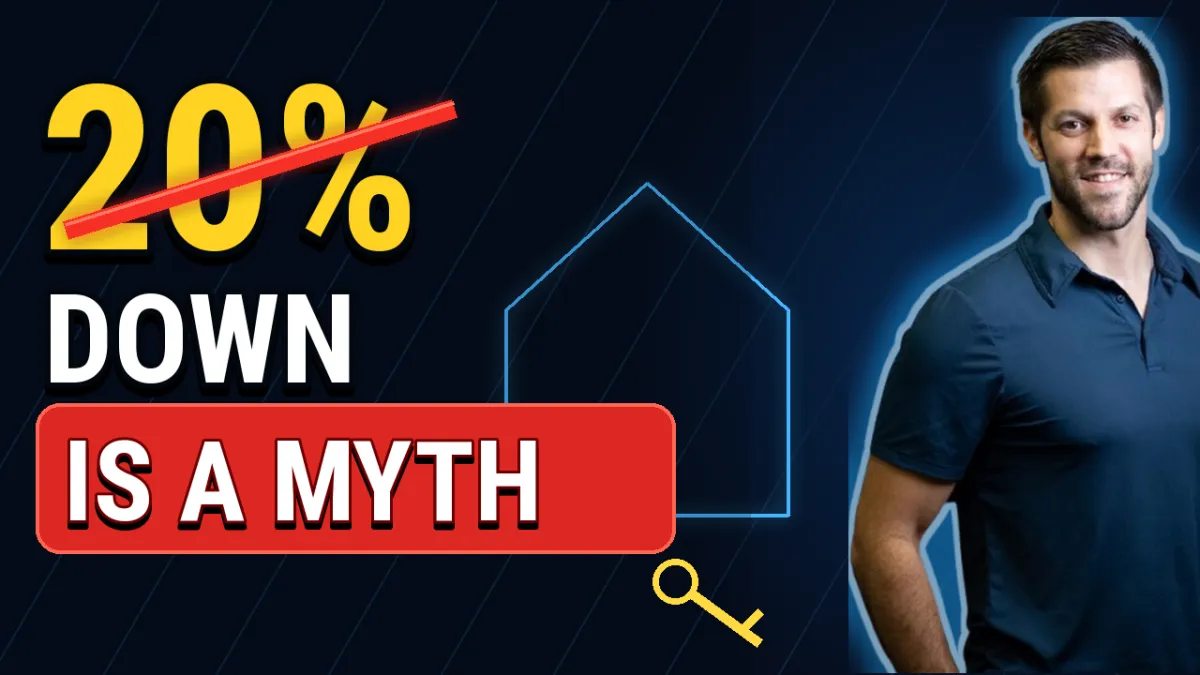
No. You do not automatically need 20% down to buy a house.
There are conventional mortgage programs with down payments as low as 3% for qualified borrowers. FHA financing can allow down payments as low as 3.5%, and eligible VA borrowers may be able to purchase without a down payment required by the VA. Each program has its own qualifications, costs, and restrictions.
Twenty percent is still a meaningful number. With a conventional mortgage, putting 20% down generally means private mortgage insurance is not required. A larger down payment can also lower the amount borrowed and may improve pricing. That does not make 20% the right answer for every buyer.
That distinction was one of the bigger points in my conversation with Realtor Zach Kidd on A Rising Tide.
The mortgage conversation should not stop at, “Can you put 20% down?”
It should start with, “What are you trying to accomplish?”
Why Do People Still Think 20% Down Is Required?
For a lot of buyers, 20% has become one of those numbers people repeat because they have heard it for years.
There is some logic behind it. On a conventional loan, reaching 20% down can remove the need for private mortgage insurance at the start of the loan. PMI protects the lender, not the borrower, and it adds another cost to the mortgage when required.
The problem comes when someone hears “20% is useful” and turns it into “20% is required.”
Those are two completely different statements.
Fannie Mae's HomeReady program currently permits down payments as low as 3% for eligible borrowers. Freddie Mac's HomeOne program also has a 3% down payment option for qualified first-time buyers. FHA says its down payment can be as low as 3.5%. Eligible VA borrowers can often purchase with no down payment required by VA.
That does not mean everybody should automatically choose the smallest down payment.
It means you have choices.
This conversation came out of a much wider discussion with Realtor Zach Kidd on A Rising Tide about mortgages, real estate, home equity, affordability, content, business, and the decisions behind building Creative 1st Mortgage. The full episode gives the stories and context behind the mortgage ideas covered here.
Is Putting 20% Down Better?
Sometimes.
If you have the cash, a 20% down payment can reduce your loan balance and eliminate PMI on a conventional mortgage. It can also leave you with a lower monthly principal and interest payment than you would have with a smaller down payment.
The real question is what happens to the rest of your financial picture after you make that down payment.
If putting 20% down leaves you with almost nothing in savings, that matters.
If putting less down allows you to keep a healthy emergency fund, that matters.
If you are an investor and the remaining cash has another job, that matters.
If the lower down payment creates a monthly payment you are uncomfortable carrying, that matters too.
There is no prize for getting a mortgage structured a certain way.
The goal is to make a decision that makes sense for your life.
A Mortgage Approval Is Not the Same as a Comfortable Payment
This is where the conversation needs to get much better.
You may technically qualify for a certain purchase price. That does not mean you should spend it.
In the webinar, Zach and I talked about buyers who receive a preapproval for one amount but personally want to shop much lower. I like that conversation.
If you qualify for $500,000 but know that your life feels better with the payment on a $375,000 house, I care a lot more about that second number.
Because your mortgage payment has to live in the real world with everything else you pay for.
That includes food, cars, kids, travel, savings, repairs, retirement, hobbies, and the life you plan on having after closing.
I have had conversations with people where the mathematical answer was yes and the practical answer was no.
If somebody is paying $2,000 in rent and looking at a $3,500 housing payment, we need to talk about where that extra $1,500 comes from.
Qualifying is one piece of the decision.
Affording the lifestyle around the payment is another.
What Costs Should Buyers Look at Besides the Mortgage?
One of the easiest mistakes to make when shopping for a house is focusing on principal and interest while ignoring the rest of the payment.
The Consumer Financial Protection Bureau identifies principal, interest, taxes, and insurance as the basic elements commonly associated with a mortgage payment. Mortgage insurance can add another cost when applicable.
For a buyer, I want the conversation to include:
Principal and interest
Property taxes
Homeowners insurance
Flood insurance when applicable
Mortgage insurance when applicable
HOA or condominium expenses
Possible special assessments
Maintenance
Cash reserves after closing
Especially in Florida, the tax and insurance conversations cannot be afterthoughts.
Florida Property Taxes Can Look Different After You Buy
A common mistake is looking at the taxes currently shown for a property and assuming that will be your tax bill too.
Florida's Save Our Homes rules limit annual increases in assessed value on qualifying homestead property after the exemption is established. That means someone who has owned a property for many years may have an assessed value that looks very different from what a new owner experiences.
For buyers in Pinellas County, the Property Appraiser provides a tax estimator specifically intended to help estimate taxes under new ownership. It allows buyers to factor in purchase price, homestead status, and portability when applicable.
That is a much better starting point than simply copying the seller's current tax bill into your budget.
Insurance Can Change the Real Cost of the House
Insurance belongs in the affordability conversation before you make a final decision.
Two houses with similar purchase prices can produce very different total monthly costs once insurance, flood exposure, taxes, and association expenses are included.
That is why I like buyers to get real property-specific numbers when they are getting serious about a house.
The sticker price is only part of the decision.
Why Can an Escrow Payment Suddenly Increase?
Escrow surprises are another reason buyers need to understand the whole payment.
An escrow account is commonly used to collect money for expenses such as homeowners insurance and property taxes. When those underlying expenses change, the required escrow portion of the mortgage payment can change too.
A shortage can also affect the payment.
Federal servicing rules allow a servicer, depending on the size of the shortage and the borrower's status, to collect shortages over future monthly payments.
So someone can have a fixed-rate mortgage and still see the total monthly payment move.
The interest rate did not necessarily change.
The property expenses underneath the payment may have changed.
That is a distinction homeowners should understand before an escrow analysis lands in the mailbox and catches them completely off guard.
What Is the Difference Between a Mortgage Broker and a Direct Lender?
A direct lender makes the mortgage loan.
A mortgage broker helps a borrower find mortgage loans from different lenders. CFPB guidance also recommends shopping around regardless of whether you work directly with a lender or through a broker.
That distinction matters to me because Creative 1st Mortgage was built around access to options.
One of the recurring themes in the podcast conversation was that a borrower hearing “no” from one place does not automatically mean no mortgage option exists anywhere.
Sometimes the answer really is no.
Sometimes the answer is not yet.
Sometimes the answer is that a different program fits the situation better.
The responsibility on our side is to know the difference.
That does not mean forcing somebody into a loan simply because we can find one.
It means doing enough work to identify the choices and then explaining them clearly enough that the borrower can make an informed decision.
The CFPB recommends speaking with multiple lenders and asking for different loan options, rates, APRs, fees, and monthly payments. It also recommends comparing Loan Estimates rather than relying only on a verbal rate quote.
That is good advice.
A mortgage should not be sold like there is one magic number.
Why Comparing Only the Interest Rate Can Get You in Trouble
The lowest advertised rate is not automatically the lowest-cost mortgage.
Points, lender credits, mortgage insurance, origination charges, closing costs, and the time you expect to keep the loan all matter.
The CFPB specifically advises buyers to compare Loan Estimates because interest rate is only one part of mortgage cost. One discount point equals 1% of the loan amount, so paying points means spending more money upfront in exchange for the pricing attached to that option.
This is why I like giving people options.
Maybe one borrower wants the lowest possible cash due at closing.
Another wants the lowest possible monthly payment.
Another plans to own the house for 20 years.
Another expects to relocate in three.
Those buyers should not automatically be handed the same answer.
Can Home Equity Become Part of Your Financial Plan?
Yes, but equity needs to be treated like a financial tool, not free money.
A home equity line of credit, or HELOC, lets a homeowner borrow against available home equity. HELOCs usually have variable rates, and because the home secures the debt, failing to repay can put the property at risk.
I talked in the episode about using home equity in my own life.
When my wife experienced a serious back injury and lost the ability to work for a period of time, we used a HELOC as part of our financial plan. The equity our home had built gave us another option while our household income changed.
That does not mean a HELOC is automatically the right answer every time life gets expensive.
It means homeownership can create financial choices that do not exist in exactly the same way when you rent.
It can become a reserve.
It can support improvements.
It can sometimes become part of a future real estate strategy.
It can also become expensive debt if it is handled poorly.
Use the tool with a plan.
Should You Use Home Equity to Buy Another Property?
There is no universal answer.
In the episode, I explained how I think about equity as part of a longer real estate strategy. Instead of automatically selling a home when moving, one possibility may be keeping the property as a rental and accessing some equity for the next purchase.
That idea has to survive the numbers.
Will the existing property cash flow?
Can you handle two properties when something goes wrong?
What are the rates and costs on the new debt?
What happens if the property sits vacant?
How much cash remains after the transaction?
Does being a landlord fit your life?
The existence of equity creates an option.
It does not create an obligation to borrow it.
What If One Lender Says You Do Not Qualify?
Ask why.
You want a specific answer.
Is the problem income?
Credit?
Debt-to-income ratio?
Assets?
Employment history?
Property type?
Loan-to-value?
The program itself?
A good answer should tell you what the actual obstacle is.
Sometimes there may be another loan structure. Sometimes the fix is waiting. Sometimes a buyer needs to improve one part of the file. Sometimes buying right now simply does not make sense.
I would rather tell someone exactly what needs to happen next than hand them a vague rejection and send them home.
That is the real value of understanding options.
It is not about finding a loophole.
It is about finding the truth of the situation.
The Better Question Is Not “How Much Can I Borrow?”
Ask:
What payment fits my life, what cash should I keep, what risks am I taking, and which mortgage structure gets me there responsibly?
That question changes the conversation.
Maybe the answer is 20% down.
Maybe it is 10%.
Maybe an eligible buyer uses an FHA, VA, or low-down-payment conventional program. Current program qualifications and pricing need to be reviewed for the individual borrower.
The number itself is not the strategy.
The strategy is understanding what every number does to the rest of your life.
That is how I want mortgage conversations to work.
Give people the information.
Show them the options.
Explain the tradeoffs.
Then let them make a decision they actually understand.
FAQ
Do first-time homebuyers need 20% down?
No. Several current mortgage programs permit qualified borrowers to purchase with less than 20% down. Examples include certain conventional programs with down payments as low as 3%, FHA loans with down payments as low as 3.5%, and VA-backed loans that may require no down payment from eligible borrowers.
What happens if I put less than 20% down?
On many conventional mortgages, putting less than 20% down means private mortgage insurance may be required. Other loan types handle mortgage insurance or program costs differently.
Is 20% down a bad idea?
No. Twenty percent can be a very good choice when it fits your finances. It can eliminate PMI on a conventional mortgage and reduce the amount borrowed. The issue is treating 20% as mandatory when other options may exist.
Should I shop around for a mortgage?
Yes. The CFPB recommends contacting multiple lenders and comparing Loan Estimates, including interest rates, APRs, fees, and monthly payment options.
Can my mortgage payment increase even with a fixed interest rate?
Yes. If taxes, homeowners insurance, or other escrowed expenses change, the total mortgage payment can change even when the principal-and-interest portion is fixed.
Should Florida buyers use the seller's current property tax bill to estimate their taxes?
Not by itself. Florida homestead assessment rules can cause long-time owners to have assessed values that differ significantly from what a new owner may face. Pinellas County provides a tax estimator designed for new ownership scenarios.
Is a HELOC the same as cash sitting in my bank account?
No. A HELOC is debt secured by your home. It lets you borrow against available equity, usually at a variable interest rate, and failure to repay can put the property at risk.