How to Use Facebook Groups for Real Estate Lead Generation
Facebook Groups for Real Estate Leads: How to Build a Community That Creates Conversations
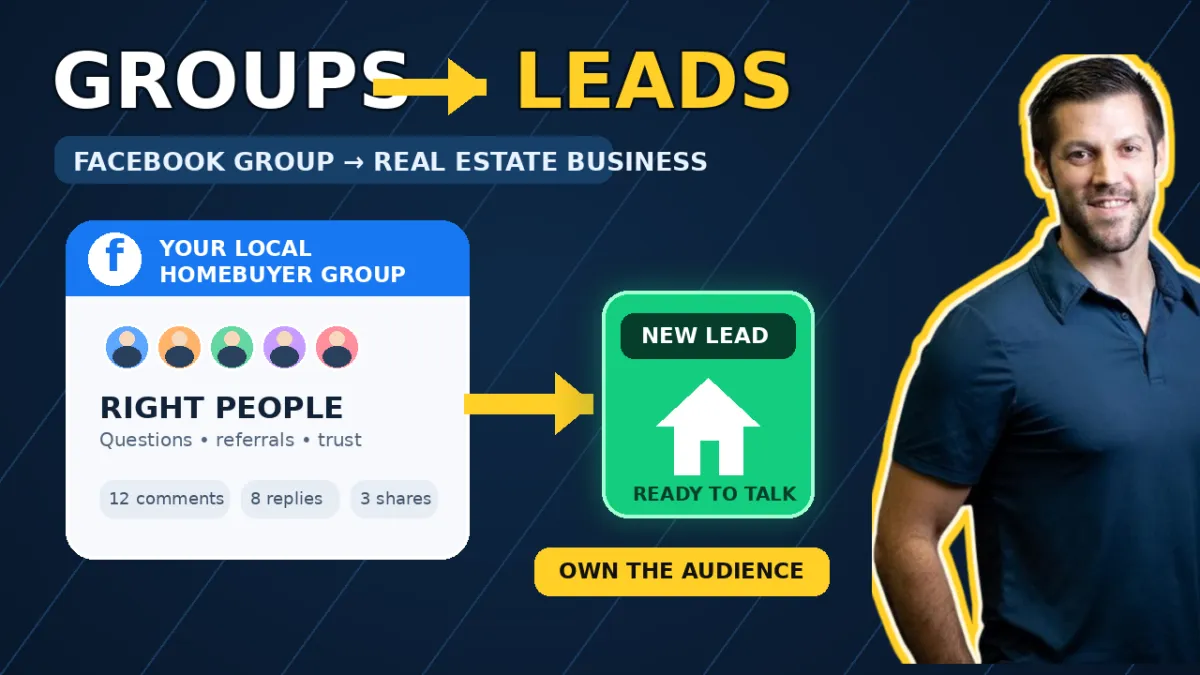
Facebook Groups can generate real estate leads, but the group itself is not the lead strategy.
The real strategy is building a place where the right people gather, giving them a reason to stay, and creating enough trust that conversations happen naturally.
That is the part a lot of people miss.
They create a group. They dump some mortgage posts into it. Nobody responds. Two weeks later they decide Facebook Groups do not work.
That is not how I built mine.
When I originally taught this strategy, I walked through a first-time homebuyer group that had grown from roughly 25 people to about 3,300 members. The group had one lender, one Realtor, and a small number of trusted professionals serving the people inside it.
It was not my entire mortgage business. I was clear about that from the beginning.
It was an add-on.
Over time, that add-on created applications, closed loans, referrals, repeat conversations, and refinance business from people who continued seeing me inside the community. Those numbers were my personal experience, not a promise of what somebody else will get.
The platform has changed since I first taught the strategy.
The part that matters most has not.
Get the right people into the room. Give them something useful. Protect the room from noise. Stay visible. Start conversations.
Do Facebook Groups Still Work for Real Estate Lead Generation?
Yes, Facebook still supports Groups as communities where people can connect, learn, and share around common interests. Meta also still gives group administrators tools for controlling membership, managing posts, organizing educational content, welcoming members, and moderating activity.
That does not mean Facebook is going to hand you leads because you created a group.
I would not build a 2026 strategy around an assumption that Facebook's algorithm is going to prioritize your group or give every post huge organic reach. Platform behavior changes too often for that.
Build around the pieces you can control.
You can control who the group is for.
You can control what gets posted.
You can control the quality of the information.
You can control whether you answer people.
You can control whether somebody who raises their hand gets an actual conversation instead of another generic marketing message.
That is a much better foundation.
The Goal Is Not a Huge Facebook Group
One of my favorite things about the group I showed in the webinar was that it was not enormous.
There were groups with tens of thousands of people in them. I did not want to manage those.
A giant group filled with lenders, Realtors, spam accounts, random promotions, and conflicting answers is not automatically more valuable than a smaller community with the right people.
My first-time homebuyer group worked because we controlled the room.
At the time, we had one lender, one Realtor, one insurance professional, one credit professional, and one title professional serving the community.
If somebody asked a mortgage question, they were not immediately hit with 16 different lenders fighting over the lead.
That matters.
Especially for first-time buyers who may already be overwhelmed.
The job of the group is not to create more confusion. The job is to make the next step clearer.
Start With a Specific Problem the Group Can Help Solve
Before you worry about content, decide who belongs in the group.
A group called something like a first-time homebuyer community has a very clear job.
Someone joining that group has already told you something about themselves.
They are interested in buying a home.
They probably have questions.
They may be trying to understand credit, financing, the buying process, Realtors, insurance, inspections, closing costs, or what they should do first.
Compare that with a generic community group.
You can still create business there, but the intent is different.
I described this in the webinar as the difference between a sniper approach and a shotgun approach. A first-time buyer group gives you a much clearer idea of why somebody joined. A general buy/sell/trade community gives you a much wider audience, but most people are not there because they are currently trying to buy a house.
That should change how you communicate with them.
Ask Questions Before People Enter the Community
One of the best pieces of the original strategy still exists inside Facebook today.
Meta currently allows group admins to ask people requesting to join or participate up to three membership or participation questions.
We used three simple questions:
What brought you to the group?
What are you struggling with right now?
Are you a real estate professional?
Those questions did more than help us screen people.
They told us what people needed.
Someone might say they were struggling with credit. Someone else might need a Realtor. Another person might have no idea where to start.
Now you have context.
You are not starting a conversation with, “Hey, need a mortgage?”
You can start with the actual problem they told you they have.
That is a much better conversation.
Meta also still gives admins control over membership and participation settings. Private groups generally require membership approval unless limited membership is enabled, while public groups work differently.
The exact setup you choose can change. The principle is the same.
Know who you want inside.
Put Useful Content in the Group Before You Try to Grow It
If I were starting another group from zero, I would still use the basic advice I gave in the webinar.
Create the group.
Bring in the trusted people helping you manage it.
Then put some good content in there before you start sending people to it.
I recommended roughly 10 pieces of content as a starting point.
They do not all need to be mortgage videos.
Mix it up.
You might have:
A simple first-time buyer explanation
A short video answering a common question
A checklist
A story from a real transaction
A post explaining something people commonly misunderstand
A funny housing-related post
A question people can answer
A post introducing the professionals helping inside the group
A breakdown of the buying process
A welcome post showing members where to start
The point is to make sure someone joining the group does not walk into an empty room.
Facebook's current Groups tools also let administrators create Guides to organize important posts around a topic. That is the current version of the educational idea I discussed in the webinar when I referred to Facebook's older learning-group and “Units” setup.
If your group is educational, use that structure.
Make it easier for somebody to find the answer without scrolling through six months of posts.
What Should a Realtor or Loan Officer Post in a Facebook Group?
The answer I gave on stage was basically, “Whatever the hell you want. It's your group.”
I still like that answer.
There just needs to be some thought behind it.
The goal is not to turn every post into an application.
A group where every post says “Call me for a mortgage” is going to get old fast.
Teach.
Answer questions.
Have some fun.
Post things people actually want to respond to.
Some of my highest engagement came from simple questions and housing-related posts that were easy for people to answer. Then every once in a while, I would make what I called a cattle call.
One example was asking people how much they were currently paying in rent.
That post created hundreds of comments in the original group and led to a large number of mortgage conversations for me.
The lesson is not that every loan officer should copy the exact post and expect my result.
The lesson is that questions create conversations.
Ask something your audience can answer without needing a 20-minute explanation.
Then pay attention to the answers.
The Money Is in the Conversation, Not the Post
This is probably the biggest point in the whole strategy.
Posting content is not the finish line.
When somebody commented on one of my posts, I would often message them and then reply publicly to let them know I had sent something.
My opening question was usually simple:
What's stopping you from buying a home?
Now we had a conversation.
Sometimes that conversation went somewhere immediately. Sometimes it did not.
That was fine.
I was not expecting every person to be ready today.
The goal was to understand where they were.
When someone was not ready, I tried to get their contact information so I was not completely dependent on Facebook Messenger to stay connected. In the webinar, I talked about keeping a simple list so I could come back six months later and check in.
That became even more important after I lost access to a Facebook account and discovered what happens when your whole system depends on one platform.
Which leads to a distinction I would make even stronger today.
You Can Control the Facebook Real Estate, but You Do Not Own Facebook
I called the strategy owning your Facebook real estate.
The phrase still works, as long as we understand what “owning” means.
You control the room.
You can create the community, set the rules, manage the content, and decide what kind of experience members get.
Meta still owns the building.
I learned that the hard way when my Facebook account was banned and I lost access to groups and years of activity.
Some of the specific platform consequences I described at the time should not be treated as current Facebook policy. For example, Meta's current help documentation says that if a group has a moderator but no admins, a moderator may be able to make themselves an admin.
The bigger lesson survives the policy change.
Do not build your entire business on access to one Facebook account.
Have more than one trusted person helping manage the community.
Keep real customer and prospect information in the systems your business controls.
When somebody gives you permission to follow up, move that relationship into your CRM or other approved contact system instead of treating Messenger like your database.
You control the room.
You still need a door out of the building.
Use More Than One Trusted Admin
My original reason for stressing multiple admins was painful experience.
I had built a large number of Facebook communities, and losing an account created problems I did not expect.
I do not need the old platform rules to make the current point.
A business community should not depend completely on one person's login.
Facebook still distinguishes between admins and moderators and gives those roles different management permissions.
Choose trusted people.
Make sure you understand what access you are giving them.
Have a plan for what happens if one person leaves the company, loses access, or stops managing the community.
That is basic business continuity.
You Do Not Have to Personally Manage Every Post
One reason people avoid Facebook Groups is that they think they are signing up for another full-time job.
You do not need to.
By the time I taught this webinar, I had already delegated a lot of the routine group work to my assistant.
I created the content.
She helped post it.
She tagged me when I needed to get involved.
I stayed involved in the conversations because that was the part I enjoyed and the part connected directly to the relationship.
Facebook currently gives admins and moderators the ability to schedule group posts, and admins can set up recurring posts. Meta also offers Admin Assist, which can automate some membership and moderation tasks based on criteria selected by the admin.
Use the tools to remove repetitive work.
Do not automate away the human part.
The person saying, “I don't know if I can buy a house,” probably does not need another scheduled post.
They need somebody willing to listen.
How Much Time Does a Facebook Group Take?
When somebody asked me this during the webinar, my answer was around 20 minutes a day for posting and replying to comments once the content was already built.
Conversations were different.
I would spend as much time as needed there because that was where the actual business happened.
I still think that is the right way to measure the work.
Do not ask, “How little time can I spend in this group?”
Ask which work has to be done by you and which work can be handled by a system or another member of the team.
Creating every post manually every morning probably does not need you.
Talking to a family trying to figure out whether homeownership is realistic for them might.
Do the right work in the right order.
How Do You Grow a Facebook Group?
The original webinar included several ways we grew groups.
We shared the group from personal and business profiles.
We worked with other professionals.
We talked about the group when someone asked a relevant question elsewhere.
We sent people into the community from other parts of our marketing.
The part I would change today is the idea that you should ignore another Facebook Group's posting rules and promote your group anyway.
Do not do that.
If somebody else built the community, respect the rules of that community.
You want to build a reputation people trust. Getting kicked out of other people's groups because you were spamming links is not a smart long-term strategy.
A better approach is to make your own group useful enough that people have a reason to share it.
Invite existing clients and contacts when the group is genuinely relevant.
Work with referral partners who serve the same audience.
Mention the community when somebody asks for the kind of education the group was built to provide.
Create content outside the group that naturally leads people toward the deeper resource inside it.
Grow the room with the right people, not just more people.
Should You Buy an Existing Facebook Group?
I talked about buying Facebook Groups in the original presentation because I had done it.
I would treat that section as historical experience, not the first strategy I would recommend today.
Buying a community does not mean you bought trust.
You may get access to a member count, but those members did not necessarily join because of you.
You still have to clean up the group.
You still have to establish credibility.
You still have to give people a reason to stay.
You still have platform dependency.
If you are deciding between spending your energy buying a random group or building a focused community around the people you actually want to serve, I would start with the focused community.
Facebook Groups Are a Long Game
This was true when I taught the webinar, and I think it is the part people need to hear most.
Do not launch a group on Monday and judge it on Friday.
Early on, you may be doing most of the talking.
That is normal.
People are walking into a room where they do not know anybody yet.
Your job is to go first.
Post.
Answer.
Welcome people.
Teach something.
Show them what kind of community they joined.
Facebook still has tools for welcome posts and new-member introductions, so you can give new members some direction instead of leaving them to figure everything out themselves.
Over time, something changes.
People start asking their own questions.
Someone posts about a problem and another member says, “I'm dealing with that too.”
One conversation becomes three.
The community starts doing part of the work a community is supposed to do.
That was when our group became valuable.
Not when the member counter went up.
When people started talking.
A Simple Facebook Group Plan for Real Estate Professionals
If I were starting from scratch today, I would keep it simple.
Choose one specific audience.
First-time buyers in a market is clearer than “everything real estate.”Define what people should get from the group.
Education, answers, local resources, and clear next steps are enough.Add trusted people to help manage it.
Do not leave the whole community dependent on one account.Load useful content before pushing growth.
Give new members something worth exploring.Set membership or participation questions where they make sense.
Learn why people are joining. Meta currently supports up to three questions.Protect the quality of the group.
Facebook currently lets admins control membership, participation, and post management.Post consistently without making every post a pitch.
Education, stories, videos, questions, and occasional direct conversation starters can all work.Respond when people raise their hand.
A comment is not just engagement. Sometimes it is the beginning of a real conversation.Move relationships into business systems when appropriate and permitted.
Do not depend on Facebook to be your permanent customer database.Give it time.
This is community building. You are earning attention and trust before you expect business.
You do not need 50,000 members.
You need the right people in the room and a reason for them to trust the people leading it.
That was the strategy when my group had 25 people.
It was the strategy when it had thousands.
And that part is still the strategy now.
FAQ
Can Facebook Groups really generate real estate leads?
Yes. The group can create opportunities for conversations with buyers and referral partners, especially when it serves a defined audience and provides useful information. The group itself does not guarantee leads. Results depend on the audience, content, participation, follow-up, market, and the work done inside the community.
What should a real estate Facebook Group post?
Use a mix of buyer education, short videos, common questions, stories, community discussions, useful resources, and simple questions members can answer. Avoid making every post a direct sales pitch.
How many people do you need in a Facebook Group before it works?
There is no required member count. Ryan's original experience showed that useful conversations and business could start well before a group became large. Quality and audience fit matter more than chasing a giant membership number.
Should a Facebook Group have membership questions?
They can be useful for screening and understanding why someone wants to join. Meta currently allows group admins to ask up to three membership or participation questions.
Can Facebook Group posts be scheduled?
Yes. Meta's current help documentation says admins and moderators can schedule group posts, and admins can also create recurring posts.
What replaced Facebook Group Units?
Meta currently calls the organizational feature Guides. Admins can use Guides to highlight important posts and organize educational material around specific topics.
Should loan officers allow other lenders into their Facebook Group?
That depends on the purpose of the community. Ryan's model intentionally limited competing professionals so buyers were not flooded with conflicting promotional messages. The bigger rule is to decide what experience you want members to have and manage the group around that purpose.
Ryan Speltz | NMLS# 1277170 | Creative 1st Mortgage | NMLS# 2614631 | Licensed in FL, MN, TX, AL, KY & TN. This is not a commitment to lend. All loans subject to credit approval, income verification, and property eligibility. Program terms and availability subject to change without notice. FHA loans require mortgage insurance. Down payment assistance is provided as a second mortgage lien. Restrictions may apply.