
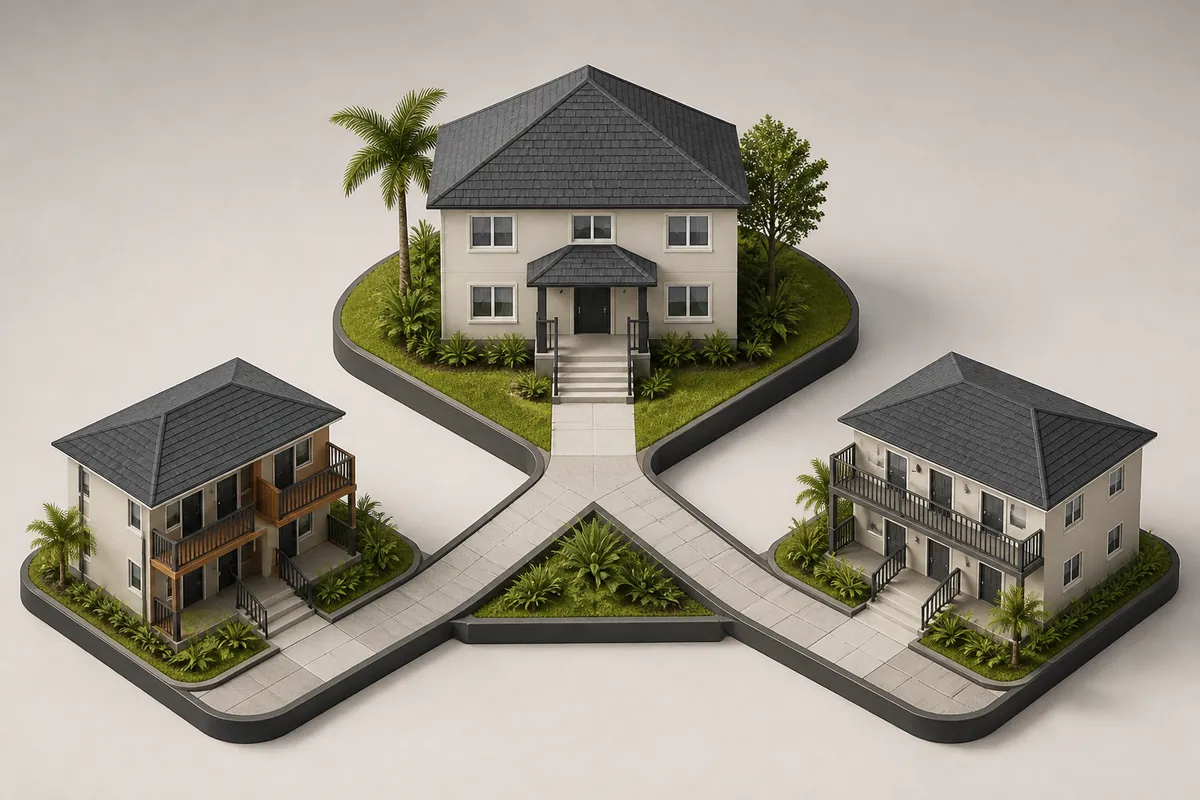
FHA Loans for Florida Triplexes and Fourplexes: Self-Sufficiency Test
Yes. You may use an FHA loan to buy a Florida triplex or fourplex if you live in one unit as your main home.
The property must also pass FHA’s self-sufficiency test. This test checks whether the building’s rent can cover its monthly payment after a required deduction.
Screen the property early. Check the appraised rents, full payment, insurance, condition, and legal unit count before making an offer.
FHA occupancy rules for a triplex or fourplex
You must live in one unit as your principal residence. The other units may be rented.
You cannot use a standard FHA purchase loan for a property that you will use only as a rental. You must have a plan to occupy one unit.
A duplex does not face this specific self-sufficiency test. The test applies to three- and four-unit properties under current FHA policy.
How the FHA self-sufficiency test works
The test asks whether the property can support its full monthly housing payment. FHA calls that payment PITI. PITI means principal, interest, taxes, and insurance.
FHA starts with the appraiser’s fair-market rent for all units. This includes the unit where you will live. FHA then subtracts the greater of:
- the appraiser’s estimate for vacancy and maintenance, or
- 25% of the total fair-market rent.
The result is the property’s net self-sufficiency rental income. Under current HUD Handbook 4000.1 guidance, PITI divided by that net income may not exceed 100% for a three- or four-unit property.
In plain language, the net rent must be at least as high as the full monthly PITI.
See the current HUD Handbook 4000.1 Update 18 and the HUD Handbook 4000.1 page before relying on this rule.
Basic calculation
Total fair-market rent for all units
minus the larger vacancy and maintenance deduction
equals net self-sufficiency rental income
The property passes when:
Monthly PITI ÷ net self-sufficiency rental income ≤ 100%
Example
Suppose the appraiser finds total fair-market rent of $6,000 per month for all four units. That amount includes your unit.
- 25% of $6,000 is $1,500.
- Assume the appraiser’s vacancy and maintenance estimate is lower.
- The required deduction is $1,500.
- Net self-sufficiency rental income is $4,500.
If the full monthly PITI is $4,500 or less, the property meets this test. If PITI is higher, it does not meet the test.
This is only an example. The real result depends on the appraisal, loan amount, rate, taxes, insurance, and other required housing costs.
Your unit counts in the rent calculation
FHA does not use rent only from the units you plan to lease.
For this test, FHA uses the appraiser’s market-rent estimate for every unit. That includes your unit.
This does not mean you collect rent from yourself. It is a way to test whether the whole building can support its payment.
The property test is not the borrower approval review
The self-sufficiency test is a property test. It asks whether the triplex or fourplex meets FHA’s rent rule.
Your lender also reviews you as the borrower. That review can include income, debts, credit, assets, occupancy, and allowed rental-income documents.
Passing the property test does not guarantee loan approval. Strong personal finances do not fix a failed property test.
For more about rental income during mortgage review, read Can ADU Rent Help You Qualify for a Florida Mortgage? An ADU is not the same as a legal triplex or fourplex.
Why the appraisal and property condition matter
The appraisal provides the fair-market rent used in the self-sufficiency calculation.
Current leases may help the lender review the property. A lease does not replace the appraiser’s market-rent estimate for this test.
The appraisal also reviews value and property condition. FHA minimum property requirements may require repairs for health, safety, soundness, or security problems.
An FHA appraisal is not a full home inspection. Consider hiring an independent inspector.
Older multi-unit homes may need close review of the roof, electrical system, plumbing, drainage, additions, and utility setup.
Florida and Pinellas County checks
Before making an offer, confirm the legal unit count. Ask about permits, utilities, access, and current leases.
Check the costs that affect PITI. Taxes and insurance can change the payment. Roof age, wind coverage, flood exposure, and building condition may affect insurance.
Do not rely only on an online rent estimate. The FHA calculation uses the appraiser’s supported market-rent opinion.
Review rents, leases, condition, insurance, and local records with your lender before signing a contract.
Ask about reserves before you commit
Reserves are funds left after closing. They provide a cash cushion.
Reserve rules can depend on current FHA policy, the full loan file, and lender requirements. Do not rely on an old chart.
Ask what funds must remain after closing for your specific loan and property. Also plan for repairs, turnover, and maintenance.
How to screen a property before making an offer
- Confirm occupancy. Plan to live in one unit as your principal residence.
- Estimate the full payment. Include principal, interest, taxes, insurance, and required mortgage insurance.
- Support the rent estimate. Current tenant rent may differ from appraised market rent.
- Use a conservative estimate. FHA requires the larger vacancy and maintenance deduction or 25% of total rent.
- Review condition early. Repairs can affect value, insurance, and closing time.
- Verify the legal setup. Check unit count, permits, meters, access, and local records.
- Review your own approval. Credit, income, assets, debts, and lender rules still apply.
If the property fails the test
A failed test means that property does not fit that FHA loan structure. It does not by itself show that the property is a bad home or investment.
Possible options may include a lower price, a larger down payment, different loan terms, stronger supported rents, or another loan program.
Each option has its own rules. Ask your lender to compare the choices for your finances and property.
If gift funds are part of your plan, read FHA Gift Funds for Down Payments and Closing Costs in Florida.
FAQ
Can I buy a Florida fourplex with FHA and rent three units?
Yes, if you live in one unit and meet FHA and lender rules. The property must also pass the self-sufficiency test.
Does the test apply to a duplex?
No. The current FHA self-sufficiency rule applies to three- and four-unit properties. A duplex may still need rent documents for borrower qualification.
Does passing the test guarantee approval?
No. The lender must also review credit, income, debts, assets, appraisal, insurance, condition, occupancy, and other requirements.
Can I use current tenant rents instead of the appraisal?
Leases can help document the property. FHA uses the appraiser’s fair-market rent estimate for the self-sufficiency calculation.
What FHA loan limit applies in Pinellas County?
FHA loan limits vary by county, unit count, and calendar year. Check HUD’s current loan-limit publication before setting a financing plan.
Official resources
- HUD FHA Single Family Housing Policy Handbook 4000.1
- HUD Handbook 4000.1 Update 18
- HUD Handbook 4000.1 supplemental documents and appraisal resources
- HUD FHA lender resources
Compliance note: This article is for education only. Loan programs, terms, property rules, and lender requirements can change. Approval is subject to underwriting, credit approval, appraisal, property condition, insurance review, and other requirements. This is not a commitment to lend.



