
How to Get Rid of Ants in Your Car in Florida
How to Get Rid of Ants in Your Car in Florida
Start with cleanup and inspection, not cabin spray. Remove food residue and moisture, vacuum the places ants can hide, and check whether they are entering from the area where the car is parked. If ants keep returning, the outdoor route may matter as much as the vehicle interior.
Florida has many ant species, and control can vary. A cautious first response is to remove food and water sources, clean the vehicle, monitor where activity returns, and use pesticide products only when the current label allows the specific pest, location, and application method.
Find where the ants are coming from
Before cleaning, look for trails rather than focusing only on individual ants. Ants may follow scent trails to food or water, so their direction of travel can help identify whether the activity is inside the vehicle or near the parking area. (ask.ifas.ufl.edu)
- Turn the vehicle off and inspect it in a safe place.
- Check floor mats, cup holders, seat tracks, door pockets, the trunk, and dashboard edges.
- Inspect the ground near the parking space, garage, driveway, or carport for trails or mound activity.
- Take a photo if possible. Florida ants vary, and treatment can differ by species.
If you suspect fire ants or another stinging species, avoid disturbing the area and consider contacting a pest professional. If practical, move the vehicle away from a visible trail or mound.
Remove food, trash, and moisture
Sanitation is a foundation of ant control. UF/IFAS recommends removing food particles and reducing moisture sources, and explains that bait works better when ants are not choosing among competing food sources. (ask.ifas.ufl.edu)
- Remove food and trash. Take out wrappers, cups, pet treats, grocery bags, and anything stored beneath the seats.
- Empty small spaces. Check cup holders, the center console, glove compartment, seat-back pockets, trunk organizers, and child-seat areas.
- Clean sticky residue. Use a mild cleaner appropriate for the surface and follow the cleaner manufacturer’s directions.
- Dry damp items. Remove wet towels, beach gear, damp mats, and leaking bottles. Let wet materials dry fully before reinstalling them.
Vacuum the places crumbs collect
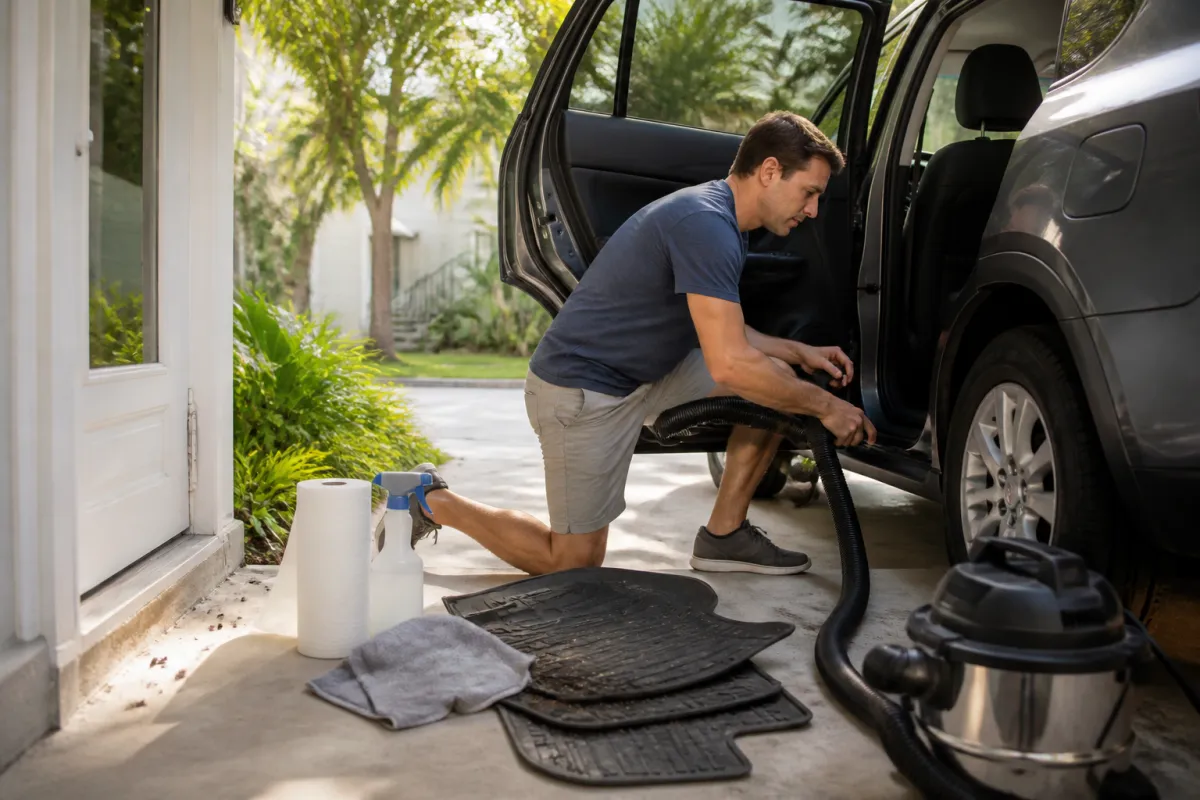
A detailed vacuuming can remove crumbs, individual ants, and debris that may support continued activity. Remove the floor mats and vacuum both sides. Use a crevice tool around seat rails, seams, console edges, door pockets, carpet edges, beneath child seats, and inside the trunk.
Empty the vacuum contents into a sealed bag and place it in an outdoor trash container. For spills in fabric or carpet, use an upholstery-safe method and avoid over-wetting the material.
Check the parking area after cleaning
After the vehicle is cleaned, monitor where activity returns. Inspect exterior door sills, the trunk seal, wheel-well areas, and the ground beneath the vehicle. In a garage or carport, look along walls, landscaping, stored boxes, and the edge of the slab.
Keep the surrounding area free of food waste, fallen fruit, plant debris, and standing water where possible. If the same trail returns after cleaning or after changing parking locations, a photo and professional inspection may be more useful than repeated random treatments.
If you use bait, follow the label carefully
For many ant species, bait can be more useful than repeatedly killing visible worker ants. UF/IFAS explains that ants may carry bait back to the colony through food-sharing behavior. Bait can take time because ants must accept it and distribute it. (ask.ifas.ufl.edu)
Do not assume that a bait belongs inside a vehicle. Use a product only when its label allows the intended pest, location, and application method. A product marketed for indoor ants is not automatically approved for a passenger compartment, upholstery, vents, or electronics.
- If the trail is clearly outside the vehicle, use a secured bait station only where the product label permits it.
- Keep bait inaccessible to children and pets, and protect it from rain or irrigation as directed.
- Do not spray insecticide or strong household cleaner around bait. UF/IFAS warns that sprays can repel ants or contaminate bait. (ask.ifas.ufl.edu)
- Continue monitoring rather than expecting an instant result.
Why spraying or fogging the cabin can backfire
Do not use an aerosol insecticide, total-release fogger, or homemade chemical mixture inside the cabin as a first response. EPA guidance favors nonchemical pest-control methods where possible and advises minimizing indoor pesticide use, following product directions, and ventilating when an approved application is necessary. (epa.gov)
Do not spray into air vents, electronics, seat cushions, or upholstery unless the product label expressly allows that exact application. A small enclosed cabin can also make residue and odor more difficult to manage.
Read the pesticide label before using a product
Pesticide labels are legally enforceable. They specify the target pest, approved locations, application method, amount, precautions, and other conditions of use. EPA states that using a pesticide in a manner inconsistent with its labeling violates federal law. (epa.gov)
- Confirm that ants are listed as a target pest.
- Confirm that the exact application site is permitted.
- Follow directions for ventilation, protective measures, and any required waiting period.
- Keep children, pets, food, and personal items away as directed. (epa.gov)
- Use only products that are properly registered for sale or distribution in Florida when registration is required. (fdacs.gov)
Never use more product than the label directs. More pesticide does not necessarily solve an ant problem faster.
Prevent ants from returning
- Remove food packaging and drink cups from the car regularly.
- Vacuum seat seams, floor mats, and cup holders.
- Dry wet mats, towels, swimsuits, umbrellas, and sports gear before leaving them in the vehicle.
- Keep the garage, carport, or usual parking area free of food waste and excess clutter.
- Watch for ant trails near the parking spot after heavy rain or irrigation.
- Address vehicle leaks or damaged seals through the vehicle manufacturer, a mechanic, or another qualified repair provider.
When to call a pest professional
Contact a pest professional when ants keep returning after cleaning and monitoring, when activity appears to come from vents or electronic areas, or when you cannot identify the route into the vehicle.
Professional help is also appropriate if you suspect stinging ants or if children, pets, allergies, or breathing concerns make pesticide use a poor fit. Ask what pest is being treated, where products will be applied, what label directions control the treatment, and what safety steps should be followed before using the vehicle again.
Frequently asked questions
Why are there ants in my car if it looks clean?
Residue can remain beneath seats, in cup holders, or in carpet seams. Ants may also be entering while the vehicle is parked near an outdoor trail. Vacuuming and checking the parking area are worthwhile even when the cabin looks tidy.
Can I use ant spray inside my car?
Do not assume that an ant spray is approved for a vehicle interior. Use a pesticide only if the label permits the specific pest, location, and application method. Avoid spraying vents, upholstery, electronics, or the passenger compartment unless the label expressly allows that exact use.
How long does ant bait take to work?
It varies. Bait may require hours or days for ants to accept it and distribute it. Results depend on the species, bait acceptance, colony location, competing food, weather, and product directions. (ask.ifas.ufl.edu)
Should I use a fogger or bug bomb in my car?
It is better not to use a fogger as a first response. Start with cleaning, moisture control, and inspection. If pesticide treatment is necessary, use only a product and method explicitly permitted by the label, or contact a pest professional. EPA recommends avoiding pesticide sprays and foggers when nonchemical pest-control methods are available. (epa.gov)
Official resources
- UF/IFAS: Ants
- UF/IFAS: Integrated Pest Management of the Tawny Crazy Ant
- EPA: Improving Your Indoor Environment
- EPA: Pesticide Safety Tips
- EPA: Introduction to Pesticide Labels
- Florida Department of Agriculture and Consumer Services: Pesticide Product Registration
Educational note: Pesticide products, labels, registrations, and safety directions can change. Follow the current product label and consult a qualified pest professional when appropriate.