Past Client Follow-Up for Real Estate and Mortgage Professionals
How Real Estate Agents and Mortgage Lenders Turn Past Clients Into Future Business
If your business feels slow, the first reaction is usually pretty simple.
I need more leads.
Maybe.
But before you spend more money finding strangers, I think there is a better question to ask:
What happened to all the people you already worked with?
That question changed a lot for me.
For years, I was good at getting the transaction done. Then we would close, everybody would celebrate, and I would move on to the next thing.
From my perspective, I was serving the client.
Looking back, a lot of it was still transactional.
The bigger opportunity was not just getting better at finding people. It was building a process where people felt taken care of before, during, and after the transaction.
That distinction matters.
NAR's 2026 Member Profile found that the typical REALTOR® reported 28% of their business coming from past clients and customers. For professionals with more than 16 years of experience, repeat business represented about half of their customer pipeline.
The relationship after closing is not some side project.
For a lot of experienced professionals, it is part of the business.
This conversation started with a simple question: what changes when a mortgage or real estate business stops treating the transaction as the finish line? In the full episode, I walk through the process changes we made at Creative 1st Mortgage and how the "seed to forest" idea changed the way I think about clients.
You May Not Have a Lead Problem
When somebody says, "I need more leads," I want to know what happened to the last 100 people.
Did you stay in touch?
Do you know what changed in their lives?
Do they still know where to find you?
Would they introduce you to somebody they care about?
Or did your relationship disappear when the transaction ended?
That is uncomfortable to look at because buying more leads feels easier. You can turn on an ad, sign up for another platform, or throw more names into the CRM.
Fixing the client experience makes you look at how you actually operate.
That includes the first phone call.
It includes your notes.
It includes what your team knows about the client.
It includes every handoff.
It includes what happens while somebody is shopping for a house.
And it absolutely includes what happens after closing.
The numbers show why that matters. NAR's 2025 research found that 66% of recent home sellers used either a referral or an agent they had worked with before.
You can spend all of your time hunting for the next person.
Or you can get much better at taking care of the people who already trusted you once.
What Does "Transactional" Actually Mean?
Most people do not think they are transactional.
I didn't.
I answered the phone. I worked hard. I solved problems. I helped people close.
But transactional behavior shows up in smaller ways.
You talk with somebody just enough to move them to the next step.
You fail to ask enough questions early, so everybody is scrambling three days before closing.
You take a call while doing five other things and trust yourself to remember what was said.
Your client explains the same situation to you, then your assistant, then somebody else on the team.
Once the loan closes or the house sells, your communication falls off a cliff.
That can still produce a completed transaction.
It just does not build much of a relationship.
A relational process asks a different question:
How can we know this person well enough, and organize the information well enough, that everyone involved can serve them without making them start over at every step?
That was one of the biggest changes we made inside Creative 1st Mortgage.
Slow Down to Speed Up
One phrase we use a lot is:
Slow down to speed up.
When a referral comes in, the temptation is to jump straight into numbers and try to get everything done immediately.
We changed that.
Our first goal is to make contact quickly and get a real conversation scheduled. Then we protect 30 to 45 minutes for that conversation.
No bouncing between six other things.
No trying to rush somebody through a checklist.
We want to understand the person.
What are they trying to accomplish?
What is happening in their life?
What concerns do they have?
Who else is involved in the decision?
What have they already been told?
What information does the rest of our team need so the client does not have to keep repeating themselves?
The mortgage still has to work.
The process still matters.
But the numbers belong inside the client's real situation.
The Consumer Financial Protection Bureau tells consumers to compare lenders on more than loan cost. Its guidance specifically points to factors such as the borrower's comfort with the loan officer's ability to answer questions and confidence that the lender can meet the required closing timeframe.
That is a good reminder for lenders.
People are not only experiencing the product.
They are experiencing you.
Better Handoffs Create a Better Client Experience
As our company grew, one of the first cracks we found was information transfer.
I could have a great conversation with a client, but if I did not document it properly, my loan partner was starting from behind.
Then the processor might be starting from behind too.
The client ends up answering the same questions repeatedly, while the team burns time trying to reconstruct information that somebody already had.
We rebuilt those handoffs.
That meant better notes.
Clear responsibilities.
A repeatable path from the initial referral to the loan partner, from the loan partner to me, and then through the rest of the process.
Systems can sound cold when people talk about them.
I see them differently.
A good system gives you more room to care because you are not relying on memory to hold your business together.
You know what happens next.
Your team knows what happens next.
The client does not have to manage you.
That gives everybody more room to focus on the person instead of constantly fixing preventable problems.
What Happened When We Changed the Process?
Our own results changed.
During the period discussed in the episode, we saw our conversion from incoming lead to at least application or preapproval activity move from roughly 20% to 40% over about three months.
We were also getting roughly 85% to 90% of incoming opportunities scheduled for an initial conversation.
Those are our internal results, not an industry benchmark.
The useful point is what changed before the numbers changed.
We did not suddenly find a secret script.
We got more intentional about response, scheduling, conversations, documentation, and handoffs.
We built a process around caring for the person.
Then we kept working on what happened after the transaction.
The Seed-to-Forest Framework
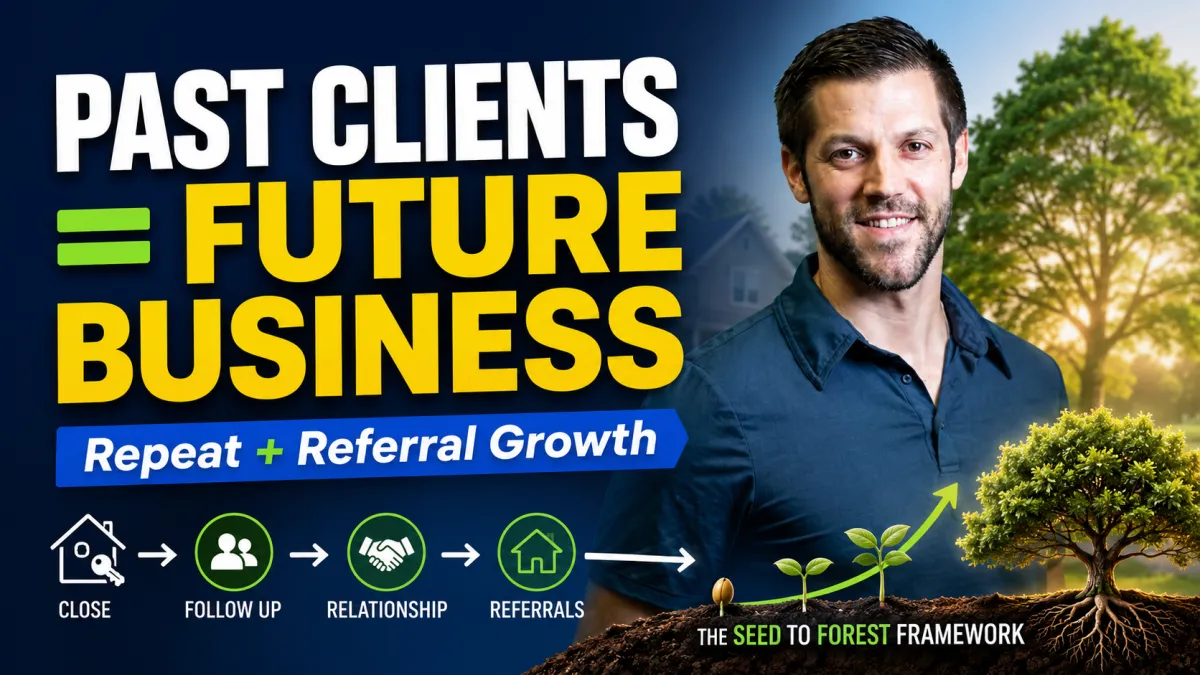
The simplest way I know to explain our approach is something we call seed to forest.
Our company logo includes the Tree of Life, so the language fits naturally for us.
A new lead is a seed.
The transaction is not the finish line. It is part of growing the seed into a tree.
Once that tree is in the forest, you do not forget it exists.
You keep taking care of the forest.
That means staying connected after closing.
It means remembering that somebody's life can change.
A person who bought a house years ago might move.
They might refinance.
They might buy an investment property.
Their kids may need a home someday.
They may have a coworker asking questions.
Or none of those things may happen for a long time.
That is fine.
The relationship still has value.
The problem starts when we spend 60 or 90 days talking to somebody constantly and then almost disappear the second we get paid.
What Should Past-Client Follow-Up Actually Look Like?
It does not have to be complicated.
The first step is simply having a plan.
For us, that includes a post-closing conversation. We want to know how things went, what we could have done better, and whether there are loose ends the client still needs help understanding.
Then the relationship moves into long-term follow-up.
A basic past-client system might include:
Scheduled personal calls throughout the year
Notes inside a real CRM
Relevant email or social content
Client appreciation events
Personal messages when something reminds you of the client
Updates that are actually useful instead of constant sales pitches
A simple way to capture introductions when they happen
I would rather have fewer meaningful touches than a database receiving noise every three days.
The point is not to remind people that you sell mortgages or houses every time you contact them.
The point is to remain part of their world.
What If You Have Ignored Your Past Clients for Years?
Call them.
I have had to do this myself.
There are people I built real relationships with, closed their transaction, then did a terrible job staying connected.
Instead of pretending that did not happen, I started owning it.
The conversation can be as simple as admitting that you disappeared, telling them you do not like that you allowed the relationship to fade, and asking how they have been.
You do not need some clever comeback campaign.
Be a person.
The vulnerability is uncomfortable because you know you could have done better.
That is also why the conversation can be real.
Some of those calls have turned into business conversations for us, including people who had another mortgage need come up but were struggling to remember how to reconnect with me.
I would rather own the mistake and rebuild the relationship than lose somebody permanently because I was embarrassed to make the call.
Ask for Introductions, Not Just Referrals
I have also started thinking differently about the word "referral."
When businesspeople ask for referrals, it can sound like we are asking somebody to identify a sales prospect for us.
That creates pressure.
I like introduction better.
An introduction is human.
"There's somebody I think you should know."
That is a different kind of conversation.
You are not asking your past client to qualify the person.
You are not asking them to decide whether somebody is ready to buy.
You are just asking them to connect two people when it makes sense.
Then it is your responsibility to take care of the relationship from there.
Client Events Are About More Than Attendance
Client events can be part of this too.
People get wrapped up in how many people show up.
That is not the only value.
The event gives you a reason to contact somebody.
It gives you a reason to say thank you.
It gives people another memory connected to your business that has nothing to do with signing documents.
For a local real estate agent, this can be pretty straightforward.
Mortgage can be more spread out. I may have clients across different parts of Florida or in other states where we operate, so one event will not reach everyone.
That does not mean you skip the relationship.
You just find a different way to take care of the people who cannot be there.
Your Content Should Support the Relationship Too
The same thinking applies to social media.
I have spent a lot of money over the years trying to figure out social content.
One of the biggest lessons has been going deeper instead of constantly trying to go wider.
Tell better stories.
Talk about your life.
Share something useful.
Let people see how you think.
Then when you do talk about the business, people already have context for who you are.
That is a much different approach from posting mortgage graphics every day and wondering why nobody wants to engage.
I also like local Facebook groups when you can contribute something useful to the community. Meta describes Facebook Groups as spaces designed around shared interests and community connection.
The key word there for me is useful.
If every post is "Call me if you need a lender," people know exactly what you are doing.
Give information.
Tell a story.
Answer a question.
Be interested in the people you are talking with.
One idea I come back to often is that you do not need to be the most interesting person in the room.
Be the most interested.
You Still Need a CRM
Caring about people is not a replacement for having a system.
Your memory will lose.
A notebook will disappear.
A spreadsheet gets buried.
If somebody tells you their daughter's name, their dog's name, where they are moving, what scared them about the process, or what they want to do three years from now, save it.
Not because you are building a manipulation file.
Because six months from now, you probably will not remember all of it.
Your CRM should help your team remember the person.
That is very different from treating the CRM like a storage unit full of email addresses.
The Goal Is Not More Follow-Up. It Is Better Relationships.
I do not think the answer is calling people every week just so your CRM shows another completed task.
People can tell when the relationship exists only because you want their next transaction.
The goal is to build a business where caring for the client is part of the operating system.
Take better notes.
Ask better questions.
Create cleaner handoffs.
Schedule conversations where you can actually listen.
Call people after the transaction.
Stay in touch.
Own it when you have not.
Create reasons to reconnect that are not always about selling something.
Do that long enough and the conversation about leads starts to change.
Because the people you have already served stop looking like old transactions.
They start looking like what they actually are.
Your forest.
FAQ
How often should a real estate agent or mortgage lender contact past clients?
There is no single frequency that works for every database. In our business, I want a system that creates real personal contact at least a couple of times a year, with other useful touches in between. A smaller database may support more frequent personal contact. The point is consistency without turning the relationship into constant prospecting.
What is the seed-to-forest client strategy?
Seed to forest is the framework we use at Creative 1st Mortgage. A new relationship starts as a seed. The client experience helps grow that relationship into a tree. After the transaction, the client remains part of the forest, which means the relationship continues to receive care rather than being forgotten after closing.
Is past-client follow-up really important in real estate?
Yes. NAR's current research shows that past clients remain a meaningful source of business for experienced real estate professionals. Its 2026 Member Profile reported that the typical REALTOR® received 28% of business from past clients and customers, while repeat business accounted for about half of the customer pipeline among members with more than 16 years of experience.
What should I put in my CRM about past clients?
Store information that helps you and your team serve the person well. That can include transaction details, important conversations, goals, family information they voluntarily shared, future plans, follow-up dates, introductions, and anything your team needs so the client does not have to repeatedly explain their situation.
How do I reconnect with a past client after years of no contact?
Do not create a complicated script. Acknowledge the gap, own your part in it, and ask how they are doing. Ryan's own approach has been to openly tell past clients that he did not do a good enough job maintaining the relationship and wanted to reconnect.
Should every past-client conversation ask for a referral?
No. If every conversation ends with an ask, it starts feeling transactional again. Stay connected because the relationship matters. When asking for business makes sense, Ryan prefers asking for an introduction rather than putting pressure on someone to identify and qualify a "referral."
Ryan Speltz | NMLS# 1277170 | Creative 1st Mortgage | NMLS# 2614631 | Licensed in FL, MN, TX, AL, KY & TN. This is not a commitment to lend. All loans subject to credit approval, income verification, and property eligibility. Program terms and availability subject to change without notice. FHA loans require mortgage insurance. Down payment assistance is provided as a second mortgage lien. Restrictions may apply.